Monday, October 31, 2011


Even more broad, this year I decided to just find some great pumpkin art. Using skeleton's as a theme, this is a compilation of pumpkin skeleton carvings. If you've procrastinated this year and need some ideas, perhaps one of these will interest you.
In an effort to provide something educational, does everyone know the history of carving pumpkins?
 This tradition stems from folklore told in Ireland, Scotland and England. The tale goes that a man by the name of "Stingy Jack" tricked the Devil into promising not to take his soul when he died. The nature of these tricks varies from region to region. In one story, Jack carved a cross in a tree the devil had climbed, trapping him until the promise was made. Jack ultimately dies and because of his orneriness is not allowed into Heaven. The devil holds his bargain as well, not allowing Jack into Hell. He's left to wander the earth as a soul. Jack begs for a light as he wanders, and the Devil kindly tosses him an eternal ember from Hell. Jack then carves a lantern out of a turnip for the light. He henceforth becomes known as Jack of the Lantern... or Jack -O-Lantern. The lantern became a part of rural superstition, as carved faces in the lantern were meant to ward off evil spirits as one walked in the dark. The lanterns were then placed on porches to guard the house overnight. On the left is an example of a traditional carved turnip lantern.
.
As people from the British Isles immigrated to the US, their autumn traditions continued, however instead of turnips, they used the more abundant and larger pumpkins. As time went by the carved pumpkin became associated with the Halloween holiday. Now, as the pictures suggest, this creative decor has evolved into elaborate creations!


Monday, October 31, 2011 1
Monday, October 24, 2011
 No, it's not an virtual autopsy. When I first heard the name of this internet company, that was my first guess. Written on the main page of their website is the message "Build your Immortality because Life is worth it". This is a new company which specializes in the "long term preservation of the digital memory of deceased people." Their claim is that their two web applications are "destined to change forever the way people deal with Death." That's a lot to live up to (pun intended).
I-Postmortem recently released I-Memorial.com and I-Tomb.net. I-Memorial is site that allows you to build your own memorial. One can post last messages to family, leave funeral instructions and last wishes. You can actually put up digital copies of wills, insurances policies etc. and have them sent to specific loved ones at the time of your demise.
I-Tomb is meant to be a virtual cemetery of sorts. Family members can put up videos, audio files and written messages in memory of the deceased. A family can just set up an I-Tomb or the I-Tomb can come from an I-Memorial account. How I understood it is that an I-Memorial becomes an I-Tomb once the author has passed. Prior to death the author designates someone to declare them dead (a "Death Declarator"). After declared dead, the personalized messages are sent out to the proper recipients or posted to the I-Tomb, whatever the author specified. The site specifically states that the switch over is irreversible, so I guess make sure someone is really dead before declaring.
This does come at a cost, but not too bad. An I-Memorial account is $120 per year and an I-Tomb is $50 per year. But you can plan ahead and prepay for up to 20 years in advance.
I don't know that this is destined to change how we deal with death but it does seem interesting. The I-Memorial is a bit Type A personality for me. I'm just not that much of a planner. I'm more interested in the I-Tomb/virtual cemetery concept. That is something I can actually see myself doing for a loved one.
Monday, October 24, 2011 0
Monday, October 10, 2011


 Yamamoto was in art school in 1996 when his 24 year old sister died, just two years after her diagnosis of brain cancer. Immediately he began to use art as a way to deal with his grief. His exploration led him to the medium of salt, which is a part of the death ritual in Japan. At the end of funerals, mourners are handed salt to sprinkle on themselves as a way to ward of evil spirits.
Not only is salt a funeral ritual, it is also allows his masterpieces to be impermanent. When the exhibit is finished, the piece is destroyed, and visitors are encouraged to take some salt and place it back in the sea. Symbolic, I think, of human life; a masterpiece that must come to an end, and the body returned back to the elements from which it was formed.
To create the works, Yamamoto uses a simple plastic bottle, often taking 50 hours or more to complete. The amount of salt used is expansive, in the range of 2000 pounds and up.
 When you look at his installations, it is obvious that the process is tedious and time consuming. This too is intentional, as Yamamoto said in an interview with the Japan Times, "I draw with a wish that, through each line, I am led to a memory of my sister... That is always at the bottom of my work. Each cell-like part, to me, is a memory of her that I call up"
I find the work breathtaking in both the intricacy and the overall finished project.
To see a video of Yamamoto at work see below or follow this link.
Monday, October 10, 2011 0
Monday, October 3, 2011
 At a recent event, I had the opportunity to watch the documentary, You Just Have to Laugh. This comedic documentary was appropriately put together by a comedian, David Naster. The impetus behind making the film was apparently a show Naster did in a church in Kansas. Afterward, a man came up and thanked Naster, saying that it had been the first time he had laughed since his son had died.
From there, Naster began exploring the topic of how we use laughter to get through the tough times. In his documentary, he interviews many different people in difficult situations, such as a gentleman with MS, a firefighter who was severely burned, people with tourettes syndrome. One interview was of a psychiatrist with a stutter talking about his experiences working a suicide hotline. Another is of a concentration camp survivor talking about the humor they found in the most horrible tasks. (The documentary points out that we may not find all these experiences funny but if it helps one cope with such a horrible situation, it was funny to them.)
Below is a video clip of Naster talking about his philosophy on laughter and death. Working on a hospice team, this really struck a cord with me.
Naster has also written books on this topic, the most recent Is there Laugh after Death? looks at stories of hospice workers and families of dying patients.
While I don't think Naster's documentary is widely available, it appears to be available at his website.
Monday, October 3, 2011 1
Monday, September 19, 2011

This photographic project was instigated by the The Straits Times, a leading Singapore newspaper, who partnered with the philanthropic Lien Foundation. Eight professional photographers captured 23 subjects in their outfit of choice for burial.
Most burial outfits are favorite clothing picked out by a patient just prior to death, or very often picked by family members. The idea traditionally is not about creativity, but respectful formal wear.
The thought from the Last Outfit project was, what if this were changed? What if our final outfit was a statement about who we are? This personal flare is quite obvious in the photographs taken. Lee Poh Wah, CEO of the Lien Foundation says, "Each exit outfit is one that best expresses the subjects' unique life. Their outfits and candid attitude have given us a fresh and fun perspective on how to deal with death. If there's something like funeral fashion,they are setting a trend by wearing their souls on their sleeves"
One of the subjects actually was on hospice for this project. Madam Foo Piao Lin had cancer and took her role more seriously. She chose an expensive cheongsam, which she had never owned, for her final outfit. She has since passed, byt her wish was fulfilled as she was buried in her cheongsam. She is pictured in the middle photograph in the series at the bottom.
The photographs are definitely conversation starters. I wonder, though, if faced with death like Madam Foo, if indeed these same outfits would be chosen.
What do you think? To those involved in hospice, how often is the last outfit actually brought up or discussed? Do you like the idea of creativity in a burial outfit or is it too much?
To scroll through the 23 images and read short bio's of the participants visit The Last Outfit web page.

Monday, September 19, 2011 2
Monday, September 12, 2011
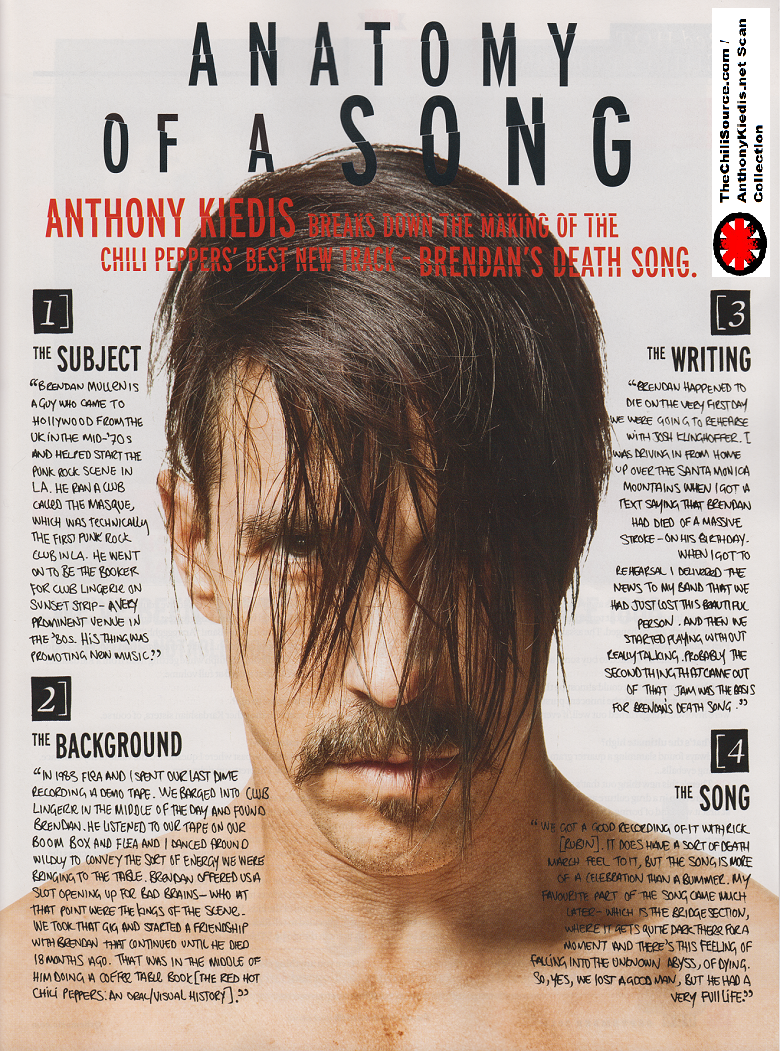
 When I was listening to the newest Red Hot Chili Pepper album, I'm with You, I discovered the song "Brendan's Death Song". The interesting lyrics really caught my attention. "Let me live, so when it's time to die, even the Reaper cries. Let me die so when it's time to live another sun will rise."
Brendan Mullen was a nightclub owner in LA. The Red Hot Chili Peppers credit him with giving the band their start. He was a friend to the band for many years and died in 2009, shortly after his 60th birthday, of a massive stroke.
The day the band found out about his death was the first day of rehearsal with their new guitarist Josh Klinghoffer. From lead singer Anthony Kiedis, "When I got to rehearsal I delivered the news to my band that we had lost this beautiful person. And then we started playing without really talking. Probably the second thing that came out of that jam was the basis for Brendan's Death Song." Kiedis goes on to say that while the song does sound like a death march, they mean it to be a celebration. "My favorite part of the song came much later-which is the bridge section, where it gets quite dark for a moment and there's this feeling of falling into the unknown abyss of dying. So, yes, we lost of good man, but he had a very full life."
Well if I die before I get it done will you decide?
Take my words and turn them into signs they will survive,
Because a long time ago I knew not to deprive.
It's safe out there now your every where just like the sky,
And you are love, you are the lucid dream you are the ride
And when you hear this you know it's your jam it's your good bye
Like I said you know I'm almost dead, you know I'm almost gone
And when the drummer drums he's gonna play my song to carry me along
Like I said you know I'm almost dead, you know I'm almost gone
And when the boatman comes to ferry me away to where we all belong
We all cross when we were feeling lost it's just the time.
Kateri cried the day her lover died, she recognized,
Because you gave her a life of real love it's no surprise.
The nights are long but the years are short when you're alive,
Way back when will never be again it was a time.
It's gonna catch you so glad I met you to walk the line.
Like I said you know I'm almost dead, you know I'm almost gone
And when the drummer drums he's gonna play my song to carry me along
Like I said you know I'm almost dead, you know I'm almost gone
And when the boatman comes to ferry me away to where we all belong
Like I said you know I'm almost dead, you know I'm almost gone,
And when the drummer drums he's gonna play my song to carry me along.
Like I said you know I'm almost dead, you know I'm almost gone,
And when the boatman comes to ferry me away to where we all belong.
Let me live, so when it's time to die, even the Reaper cries.
Let me die so when it's time to live another sun will rise.
Yeah, yeah yeah, yeah yeah
Like I said you know I'm almost dead, you know I'm almost gone
And when the drummer drums he's gonna play my song to carry me along
Like I said you know I'm almost dead, you know I'm almost gone
And when the boatman comes to ferry me away to where we all belong
Like I said you know I'm almost dead, you know I'm almost gone
Like I said you know I'm almost dead, you know I'm almost gone
Like I said you know I'm almost dead, you know I'm almost gone
Monday, September 12, 2011 0
Monday, September 5, 2011
 I came across this inspiring story of artist Casey Shannon. Casey is an artist that lives in Carmel Valley, California. At the age of 36, already a mother, wife and high school art teacher, Casey had a massive left hemispheric stroke. The stroke was debilitating, leaving her aphasic, wheel chair bound and with no use of the right side and little use of her left side.
She writes about the loss of identity and longing for her old self on her website here. As a part of her recovery she learned about Wabi Sabi which is the Japanese tradition of celebrating the beauty in what's flawed or worn. She also turned to art, writing that, "as soon as I could sit for more than just a minute in my wheelchair, I began practicing holding a pencil in my left hand and started doodling and scribbling and such. I intuitively knew that, for me, I needed to get drawing again. And fast, if I was going to save myself"
She ended up drawing 5 pictures a day, having incorporated it into her daily home rehab program. The act of creative expression helped to improve her self-worth and self-esteem.
 It's been 19 years since her stroke, and Casey has regained her speech and the ability to walk, though has lost the use of her dominant right arm. She continues to paint, teach and inspire other stroke survivors with her story.
Casey graciously includes art work on her website from before the stroke, during recovery and current pieces. The first piece above is a sketch done in the year or two prior to her stroke. Her drawings from her recovery period, are taken from about 4 years post stroke. At that point in her process she combined inspirational sayings with her drawings, like the picture to the right.
 As she has recovered, her style completely changed, not only because she now uses her left hand, but because she now does contemporary sumi-e paintings. Sumi-e painting incorporates meditation before painting. As Casey describes on her artist's page, "I concentrate on trying to capture spirit as the ink is transferred to the paper with the stroke of the brush....If your intention is correct, the object in the picture seems to 'breath and take on life'"
I find Casey's story a good reminder of the power art can play with our patients dealing with debilitating disease.
For more of Casey's paintings check out her galleries here.
Monday, September 5, 2011 0
Monday, August 29, 2011
 A few weeks back, when my husband and I were on vacation in London, we came across an interesting tour. There were lots of tours we saw advertised but this actually came highly recommended by friends. It was the Jack the Ripper Tour (there are actually several of them by different companies). It is a nighttime tour that goes through the streets and alleys of the Whitechapel area to sites of the famous murders. We ultimately didn't end up taking the tour. I thought I could go without experiencing London through the eyes of a serial killer. I've never felt the need to stand at the site of a famous murder. But many do enjoy this. This led me to do a little but of research on the topic.
Did you know that for $225-250 you can stay in infamous accused murderer Lizzie Borden's actual bedroom? You can take a tour of the house (now bed and breakfast) and museum. In Chicago, you can take the Devil in the White City Tour, which looks at serial killer Henry H. Holmes. In LA you can take a Helter Skelter bus tour to see the sites of the Manson murders. This Obit Magazine article talks about a Boston tour that plays up the sites of South Boston mob boss James “Whitey” Bulger.
So where does historic interest turn into some morbid type of voyeurism? People visit sites like Auschwitz all the time. I've never really thought twice about this, as it seems like something that needs to be seen. (To me, I guess. Others may think differently.) So what makes this ok and the Helter Skelter Tour seem so wrong? Is it time passing? (How much time does need to pass before it is socially acceptable to start a bus tour?) The historic value of the site? A lesson you might take away?
I know that there are people who are just serial killer and famous murder buffs. Just like my husband loves WWII history and my sister is obsessed with the British monarchy, there are those that just find this sort of thing fascinating. It's a personal taste thing, I suppose. Maybe I just don't get why someone would want to be reminded of such horrible things. Isn't life difficult enough as it is?
Monday, August 29, 2011 3
Monday, August 22, 2011

During 1963-65 Johnson produced 12 unbound pages of mail art for something called "A Book About Death". He sent these one page essays about death to other artists in the correspondence school. Johnson committed suicide in 1995 and in an effort to commemorate him the art project "A Book About Death" was started.

 In 2009 artist Mathew Rose, taking inspiration from Johnson's death themed art pages, organized a massive exhibition of similar mail art. The call went out to artists all across the world to submit postcards on the theme "A Book About Death". The artists were to create 500 postcard copies of their pieces and mail them to the gallery of the exhibition. During the show, which was held in September 2009, visitors could then collect postcards from the hundreds of artists and take the postcards home to create their own unique book about death.
Since the original ABAD show, there have no been 23 installments, as the project continues to move around the world with new additions continually. Each ABAD exhibit is slightly different, some like the recent exhibit in May at the Willo North Gallery in Phoenix, Arizona called for postcards with a memento accompanying it.

I've enjoyed browsing the images for the different shows, a few which are included here. The interpretations on death are as diverse as they come. Some of the pieces are accompanied by poems, like this piece below with image on one side, and the poem on the back of the post card.


I wonder if there would be a place to do some collage work as a self care session for hospice and palliative care in this way, or perhaps a work shop at a national convention resulting in a Hospice and Palliative Medicine edition to A Book About Death?
Art work credits from top to bottom:
Steve Dalachinsky
Laura Sharp Wilson
"The Call" Sophia Oldsman
"Sustenance" Kim Triedman
Monday, August 22, 2011 1
Monday, August 15, 2011
 This HBO documentary looks into the life and death of Diane Schuler. In 2009, Diane was involved in a head on collision that killed her daughter, 3 nieces, 3 men in the other vehicle and herself (her son was the only survivor). It analyzes Diane's life through her friends and the hours leading up to the accident through cell phone calls, police, eye witnesses and surveillance video. She had been noted to be driving erratically and then drove the wrong way on an interstate for 1.7 miles. An autopsy of Diane revealed a blood alcohol level of 0.19 and high level of marijuana in her system.
To Diane's grieving husband, she was a perfect wife and mother. He is adamant that she would never have drank while in the car with the children and that the results of the autopsy are false. He has contested these findings even after the discovery of a bottle of vodka in the car. He grasps at any possibility (a tooth abscess she had several years ago causing her to have a stroke which led to her drinking the alcohol by mistake).
What interested me are all of the interviews of the family members on both sides. Her husband, family members and friends reminiscing about the Diane they knew and looking for any answers, any other medical reasons she behaved the way she did. On the other side, the family members of the 3 men killed in the vehicle she hit, angry that her husband continues to deny what the evidence shows. (The parents of the three nieces killed did not participate in the documentary.) It even goes into the grief and trauma of the witnesses to the accident.
Most of what they present is from the view of Diane's husband and sister-in-law. You find yourself wanting to buy into their blind faith in Diane, even though you know what the evidence shows.
The documentary is very well put together. It easily moves from the accident to the distant past to the present. They integrate the medical and other evidence along with psychiatric assessments of the Diane and her family. (The graphic accident photos I could have done without). It's a medical mystery along with a unique perspective on grief. What happens if the person you are grieving is possibly at fault in the loss? Was she really the person that everyone thought they knew?
Monday, August 15, 2011 0
Monday, August 8, 2011

 The medium he chose, however, was not his usual computer based work, but that of cartoon. Many of his memories and experiences were so visual that he decided to draw them out. The outcome is a stunning and beautiful tribute to Mackintosh's father. The graphic novel, published by Com.x in April is entitled "Seeds".
I was drawn immediately to the images;their minimalist nature serves the heavy topic well. The reader journeys from time of diagnosis to time of funeral. Interspersed in the narrative of the events are deeper concepts such as genetics, relationships and purpose. Also accompanying the story are the very real moments of humor and tragedy. It is this combination that allows the reader to connect and perhaps even find their own personal stories in this work.

Mackintosh's father spent time in hospice and there is a great conversation where the physician communicates prognosis by saying "When people in your father's position deteriorate monthly, they usually have months to live....When they deteriorate weekly, they usually have weeks to live.... Your father has been deteriorating daily..."
 The medium of cartoon really forces the themes and concepts to be whittled down to absolutes... gone is the ability to hide in verbose prose or get lost in mundane details. This really makes this graphic novel quite raw, and most of the reviewers I read mentioned reading with lumps in their throats, as the images and few words struck familiar nerves of mortality and loss.
This certainly is one that should be considered for our personal and/or palliative medicine libraries and it may very well attract unsuspecting readers going through the experience of loss.
All images are Copyright Ross Macintosh.
Monday, August 8, 2011 1
Monday, August 1, 2011
Monday, August 1, 2011 0
Monday, July 25, 2011
I discovered Redemption Song on the Rolling Stone top 500 songs list. It is listed as #66, stuck between #65 Sunshine of Your Love by Cream and #67 Jailhouse Rock by Elvis Presley. I had never heard it before, as I have never been acquainted with Bob Marley's music.
The song Redemption Song is the final song on Bob Marley's album Uprising, the last album that was released during his life time. (One more album, Confrontation, came out after his death.) The lyrics for the song were taken from a speech given by journalist and orator, Marcus Garvey. "We are going to emancipate ourselves from mental slavery because whilst others might free the body, none but ourselves can free the mind."
At the time Marley wrote Redemption Song, he had already been diagnosed with melanoma. He was already dealing with a lot of pain issues and his own mortality. Many consider it to be a sort of summing up of Marley beliefs and it is considered some of his best work.
Marley died in 1981 at age 36.
Old pirates, yes, they rob I;
Sold I to the merchant ships,
Minutes after they took I
From the bottomless pit.
But my hand was made strong
By the hand of the Almighty.
We forward in this generation
Triumphantly.
Won't you help to sing
These songs of freedom?
'Cause all I ever have:
Redemption songs,
Redemption songs.
Emancipate yourselves from mental slavery;
None but ourselves can free our minds.
Have no fear for atomic energy,
'Cause none of them can stop the time.
How long shall they kill our prophets,
While we stand aside and look? Ooh!
Some say it's just a part of it:
We've got to fulfill the Book.
Won't you help to sing
These songs of freedom?
'Cause all I ever have:
Redemption songs,
Redemption songs,
Redemption songs.
Emancipate yourselves from mental slavery;
None but ourselves can free our mind.
Wo! Have no fear for atomic energy,
'Cause none of them-a can-a stop-a the time.
How long shall they kill our prophets,
While we stand aside and look?
Yes, some say it's just a part of it:
We've got to fulfill the book.
Won't you have to sing
These songs of freedom? -
'Cause all I ever had:
Redemption songs -
All I ever had:
Redemption songs:
These songs of freedom,
Songs of freedom.
Monday, July 25, 2011 2
Monday, July 18, 2011

The urn itself is simply a vessel or vase without handles. The urn was used in ancient Greek and Roman times for oils, as well as cremation ashes.
Today after cremation, the options are quite diverse on what is done with the ashes. Many people scatter ashes, so have no need for an urn. Other people use the urn for the ashes and have the entire thing buried in a cemetery plot or placed above ground in the cemetery columbarium (a specific place within a mausoleum for urns). Just like eco-friendly coffins, they also make bio-degradable urns. Another choice is to bring the urn with the ashes home, keeping the departed's remains with you at all times.
When an urn is used, there really is no industry standard. The typical size for an individual may be to hold 170-350 cubic inches, whereas the popular couple urns hold 400-500 cubic inches of ashes. Materials used range from paper, glass and wood, all the way to metals, ceramics and marble. And if you thought shape mattered, this too is up for negotiation. Urns can look traditional and vase like, or look like an item. I even saw examples for photo frame urns and music box urns.


 Portrait urns like the kind done by artist Ruby Lindell, are hand painted ceramic urns such this example on the right.

Unlike coffins, urn's offer an extremely wide variety of creative options, allowing a very personalized urn if desired. What I find interesting is that some of the urns look so much like traditional home decor, that the memorial could easily blend in, completely disguised to house guests.
Monday, July 18, 2011 1
Monday, July 11, 2011
 June 25th, 2011 marked the second anniversary of the death of Michael Jackson. I find it very interesting how iconic celebrities like Jackson are commemorated.
The town of Gary, Indiana, Jackson's boyhood home, has promised a yearly tribute to the King of Pop. This outdoor event includes music, vendors and ends in a candlelight vigil at dusk. It's held at the old Jackson family home. On the first anniversary of his death the city unveiled a monument to Jackson.
Jackson's "Thriller" jacket (the red jacket worn in his Thriller video, seen above) was auctioned off for $1.8 million this year on the June 25th. Apparently a portion of the proceeds will go to the Shambala Preserve, home to Jackson's two Bengal tigers, Thriller and Sabu.
But my absolute favorite way that Jackson was commemorated was various dancing flash mobs. (Flash mobs have made the news a lot lately as there are apparently stealing flash mobs where a group mobs a store and just walks out with merchandise.) These are large groups of people getting together and suddenly breaking into dance. Since his death, these have occurred all over the world from China to Mexico. The video below was taken in Stockholm, Sweden in the weeks after Jackson's death. I found it impressive.
The video below was in San Francisco, this year.
Monday, July 11, 2011 0
Monday, June 27, 2011

After 40 years of marriage, Angela was diagnosed with cancer, and in 2006, 2 years after her diagnosis, died from the disease. Her husband then began his journey into an uncertain world without her. His photographs became his response to the grief he was experiencing. His work was published in November and is entitled "Corridor of Uncertainty" (2010 Dewi Lewis Publishing)
 The title itself is steeped in metaphor. Although those of us in the states may be unfamiliar with the phrase, it actually comes from the sport of cricket, and refers to a place that a batsman struggles most to determine whether to play the ball or leave. Apropos for someone mourning... Paul Hill writes, "Bereavement, for me, is being between two states: what has been and what may take place in the future. The work that I have made mirrors this interstice"
 We have seen other artists document death, but I found it interesting that he writes about his images, "Of course they are informed by the harrowing experience of my wife's fatal illness, but I did not - could not- document her decline directly."
When I glance through the images I am struck by the emotional nature of the pictures. Even had you not known his wife had died, looking through the images as a collection, you'd surely have felt that something tragic had occurred. The images are quite raw and intimate and I'm grateful that Paul Hill decided to share his process with us.
His book is not the end of the matter either, in fact, it seems to be just the beginning. Currently Paul Hill is involved in a research project looking at photography, bereavement and grief. A website at De Montfort University explains the hopes for the project.
I encourage you to take a minute to glance through some of the images from his book, follow this link to do so.
Monday, June 27, 2011 0
Monday, June 13, 2011
 Watching the evening news a while back I enjoyed the interview of music legend Paul Simon with Brian Williams on NBC. My ears pricked up when I heard the following part of the interview:
PS: "I'm not crazy about dying"
BW: "I don't know a big fan...."
PS: "No, not too many. I'm trying to come... I'm trying to not be pissed off about that" and a little later...
PS: "We were always told that your capacity for thinking sort of diminishes as you get older...but now I'm 69 years old and I think the opposite, I think that it's better. So I look forward to seeing what more time will reveal."
Immediately I wondered about Simon's contemplation on aging and death. I went to work looking at his repetoir of songs to find out what he's been saying in his lyrics about death over the last 4 decades.
The first I found was released in 1972 entitled "Mother and Child Reunion". From an interview with Rolling Stone that same year Simon explained the inspiration; "Last summer we had a dog that was run over and killed....It was the first death I had ever experienced personally....I felt this loss - one minute there, next minute gone, and then my first thought was, "Oh, man, what if that was [my wife] Peggy? What if somebody like that died? Death, what is it, I can't get it"
Knowing the inspiration then, the lyrics to the song fit, "I can't for the life of me/ Remember a sadder day/ I know they say let it be/ But it just don't work out that way/ And the course of a lifetime runs/ Over and over again." However, just listening to the melody and upbeat tempo, you'd be hard pressed to hear this and think it was a mournful song.
In 1977 Simon released "Slip Slidin' Away". There is not a lot of background known as to the inspiration for this piece, but clearly, there are palliative care themes in this. Many think the "destination" described in the chorus represents death, others may quip that it is a metaphor for any goal or hope for one's life. Regardless the 4th stanza that says "God only knows/ God makes his plan/ The information's unavailable/ To the mortal man/ We work our jobs/ Collect our pay/ Believe we're gliding down the highway/ When in fact we're slip slidin' away" sounds a lot like someone who is aware of their own mortality.
"The Late Great Johnny Ace" was released in 1983 and is very autobiographical. Simon was 42 when this was released, and you can sense his maturity in the song. We are taken on a journey revolving around death and life. The song opens with Simon as a 12 year old hearing about Johnny Ace's death. Too young to really comprehend this reality, yet somber still the same, the song then shifts dramatically in tempo and melody to a more joyous time of the 60's. The listener has the sense that Simon feels young and immortal. The final third part changes back to the opening melody as Simon hears of John Lennon's death. He connects the news back to the late Johnny Ace's death, except now the sentiment is more personal. I find it haunting that the song concludes with a Phillip Glass instrumental piece, bringing an emotional climax to mortality, as one can imagine in the pulsating melody a clock ticking one's life away.
Finally we turn to Simon's recent album So Beautiful, or So What released this April. Just as the opening interview with Brian Williams suggested, Simon, now 69 years old, is even more aware of issues regarding aging and death. There are a couple of songs on this album that deal with death and mortality. In "The Afterlife" he pokes fun at death with the opening words, "After I died, and the makeup had dried, I went back to my place" and near the end "After you climb, up the ladder of time, the Lord God is near. Face to face, in the vastness of space, your words disappear."
The more serious is "Love and Hard Times", which though not directly discussing death, is certainly a life reflection. The beginning sets up the human condition with a narrative about God coming and then deciding to disappear, "anyway, these people are slobs here". The song then moves into a love ballad, and three stanzas cover their first meeting, hard times when love was gone and finally a present moment of gratitude. The last verse could easily be someone on their death bed, in a still room, "The bedroom breaths in clicks and clacks/ Uneasy heartbeat, can't relax/ But then your hand takes mine/ Thank God, I found you in time"
All in all when I reflect over these works that cover 40 years I get the sense that Paul Simon has often been reminded that life is short. I get the feeling that this awareness allows him to focus on the important things. His statement then "I'm not too crazy about dying" may be less a fear or denial of death, than a realization that he has much more life to live, because life is good these days.
Monday, June 13, 2011 0
Tuesday, June 7, 2011
 Breaking Bad is an AMC television show that I recently discovered. It is starting it's fourth season this summer, so it's not a new series. But after I watched most of the first season, I knew it had to be a post.
Walter White is an over qualified chemistry teacher with a 15 year old son with cerebral palsy and a wife who is 7 months pregnant. He discovers that he has terminal lung cancer. Knowing his time is likely short (I think 18 months is what was mentioned in the show). He sets out to make money to pay for expensive treatments to support his family after his death. He does this by joining with a former student, putting his chemistry knowledge to use, to make meth.
Overall the show is a drama with a lot of drug dealing and violence. Walter turns out not to be the mild mannered chemistry teacher type. But I found the cancer angle to be very interesting. There are some very interesting palliative care type scenes. Early on in the show (Season 1) Walter was refusing to talk about treatment. His family had an intervention to discuss his choices with him.
I wasn't able to find the exact clip of his intervention but below is a "Minisode" (essentially the highlights of season 1 episode 5). The scene starts at 3:18. It isn't the complete scene but hits most of the key points. Marie is Walter's sister-in-law (who is actually a doctor) and Hank is her husband (who is a DEA agent, the plot thickens). Please forgive the brief advertisement.
Here is a clip of series creator Vince Gilligan talking about how emotional this particular scene was to make.
I love the talking pillow. Hmm, may use that in a family meeting. I really like the speech Walter gives at the end. Choosing to do nothing is itself a choice and was actually a much more thought out one than his family anticipated. While I wouldn't really call this series completely palliative care, it is an excellent drama with excellent acting.
Tuesday, June 7, 2011 0
Monday, June 6, 2011
 This post topic came to me thanks to my Google alerts (a way you can get email updates on your choice of topic). It's a great way to get updates on topics you are interested in without having to periodically Google them.
Fereydoun Ave, a modern Iranian artist recently displayed his newest works, entitled "Recent Works" at the Khak Gallery in Tehran. Ave's work before this  had included collages that merge the figures of Iranian wrestlers with ancient reliefs of Persian kings and warriors. He had focused a lot on ancient masculine figures. So what does this have to do with palliative care, you may ask?
This show marks a departure from Ave's earlier work. This show illustrates his own personal history after surviving a long illness. I couldn't find exactly what his long illness was (the doctor in me sooo wanted to know). I only found that this work is meant to tell that story.
Ave's latest show includes 11 mixed media pieces and 7 sculptures. "Each of the mixed-media works begins with haphazard schemas and splashes of watercolor. The artist then prints familiar snapshots of daily life. Finally he over-paints them with new watercolor splashes." His sculptures have an archaeological feel to them.
I leave the interpretation of modern art up to the reader. Ave doesn't provide any explanation for each piece. His different pieces show flowers, a world map with superimposed flowers, a photo of a chair by a window with blinds, a chalice, and a family portrait. I would be interested to know what you think.
More of Ave's work can be seen here at the Khak Gallery website.
Monday, June 6, 2011 1
Monday, May 23, 2011
 I finally got around to seeing Rabbit Hole, which just came out on DVD in April. It stars Nicole Kidman and Aaron Eckhart, who portray a couple that has lost their young son to a tragic accident. The teaser from Rotten Tomatoes says it "is a vivid, hopeful, honest and unexpectedly witty portrait of a family searching for what remains possible in the most impossible of all situations" Simple translation: This is a movie about grieving.
The couple deals with their grief in two totally different ways. Becca (Kidman) seems to want to erase everything that reminds her of her son and rarely shows emotion. In one scene her husband Howie (Eckhart) confronts her about this, "You're trying to get rid of him.......You have to stop erasing him. You have to stop it!" To which she answers "Do you really think that I don't see him every second of every day?.........It feels like maybe I don't feel badly enough for you. Maybe I'm not feeling enough. What do you want from me?"
Howie has several angry outbursts in the movie, which seem to be part of his grieving process. He also strikes up a friendship with a woman from his grief group, played by Sandra Oh.
The grief group has some stereotypic characters, including another couple who has spiritualized the loss of their own child. Becca's confrontation of this made me smile. The couple shares that the reason their daughter died was because God "needed another Angel" to which Becca pipes up, "Why didn't He just make one?... I mean He's God after all?!? Why didn't He just make another Angel?"
Interestingly we learn that Becca's brother died years prior, so Becca's mother Nat(Dianne Wiest) has great potential to be of comfort, if Becca would allow her to be. Finally towards the end, Becca connects with her mom and their exchange is one of my favorite moments of the movie. I love how Nat describes grief.
Becca: Does it ever go away?
Nat: No, I don't think it does. Not for me, it hasn't, and that's goin' on eleven years. It changes, though.
Becca: How?
Nat: I don't know....the weight of it, I guess. At some point, it becomes bearable.It turns into something that you can crawl out from under and...carry around like a brick in your pocket. And you... you even forget it, for a while. But then you reach in for whatever reason and - there it is. Oh right, that. Which could be awful- But not all the time. It's kinda...not that you like it exactly, but its' what you have instead of your son, so you don't wanna let go of it either. So you carry it around. And it doesn't go away, which is...."
Becca: What?
Nat: Fine...actually.
Overall, I thought this was a good movie about grief. The characters do heal during the movie, which is always nice to find your characters growing. I also enjoyed the sub context looking at the question of where one finds comfort in grief. This was mentioned and explored outwardly in many ways, from looking to religion, to other relationships, and even to parallel universes.
If you haven't seen it, check it out and do let us know what you think.
Also, here's the trailer if you want to get a feel for the movie visually.
Monday, May 23, 2011 2