

Thursday, April 12, 2012
 The Alzheimer's Project is an HBO documentary series that debuted in 2009. It consists of 4 documentaries that look at the science of the disease and those affected by the disease, the people with the disease, their caregivers and children. There is also a supplementary series of short videos.
What really caught my attention in this three year old series was the documentary entitled "Grandpa, do you know who I am?" It was narrated by Maria Shriver whose father, Sargent Shriver, suffered from Alzheimer's. (He died in 2011.) This video was geared toward children dealing with grandparents with Alzheimer's.
They followed several different children in different circumstances. One family of children was having an open conversation with their grandfather with early Alzheimer's about what was happening to him and how he was dealing with it. One girl was helping to care for her grandmother in her home and another had a grandmother in a nursing home.
The very emotional part of the video was when they discussed some of the behavioral changes in their grandparents. One child described her nursing home bound grandmother slapping her for no apparent reason. In another scene, a grandmother yells at her granddaughter to leave when she tries to read to her.
The video is mixed with messages for children dealing with similar situations, like this is the disease not really your grandparent and try to be a keeper of your grandparents memories.
This documentary series is very well done as HBO documentaries tend to be. It was made in collaboration with National Institute on Aging. What I really appreciated is that the videos are all available online here.
Thursday, April 12, 2012 1
Monday, January 18, 2010
 Judith Fox is a writer and photographer based in Southern California. Eleven years ago, having just been married to Dr. Edmund Ackell 3 short years, Judith's multi-talented husband was diagnosed with Alzheimer's disease. This strong, intelligent man, who has been a surgeon, pilot, artist, athlete and president of Virginia Commonwealth University is now the subject of Judith Fox's book "I Still Do: Loving and Living with Alzheimer's Dementia" published by powerHouse Books in Oct. 2009.
 She says in an interview posted on the powerhouse website, that as a photographer, taking pictures of him was another way of loving him. In fact, it allowed her to see him more clearly.
I am always on the hunt for photographic memoirs centered around end of life issues, and this book certainly captures end of life themes. The book is 128 pages, with intimate photographs of her husband and thoughtful insights by the author to accompany the images.
Judith writes, "Alzheimer's doesn't announce itself with an ache, a pain, a limp. It rolls in like a fog. It dissipates. It leaves space for denial."
How often I hear this when speaking with families whose loved ones are in the end stages of dementia. "When did the symptoms start?" I'll ask, and always there is a hesitation. It is a fog, so gradual and faint at first, most don't even notice it's presence. I find this photograph from the book extremely poignant when coupled with Judith's words. The illusion is as if the rest of the "real" Ed has vanished, with only a hand remaining. Next to the photo she writes that dementia, "Unveils the person we married and then replaces him with someone who doesn't know our name".
There are tender moments captured, where Ed sleeps with their cat, or rests in a chair. But there are also photo's that you see in his eyes a question. As though he is not quite sure what's occurring, or even who the photographer is. She is very honest in her accounts as caregiver. I particularly resonated with her thoughts on delirium. She writes, "Who thought up the innocent-sounding euphemism 'sun-downing' to describe the anxious and erratic early-evening behavior? Let's be honest, here. How about 'howling at the moon'? How about 'clawing at the walls'? How about the 'twilight zone'? 'Sun-downing'? PLEASE. "
Overall the book places a soft focus on a devastating disease. Although honest in her account, one walks away with the feeling of her love and commitment to this man, instead of feeling doomed and exhausted from the disease. I suppose that's why the title is "I Still Do".
To see more photos, you can check out a series of 13 of the photographs located at Judith Fox's photography site here. To hear the author speak and read a few passages go to the powerHouse website here.
Monday, January 18, 2010 6
Monday, September 28, 2009
The nice thing about art is the ability to interpret a piece from your own perspective based on your life experiences and knowledge. Tonight I will attempt a great feat by turning a song about being left alone and ignored on the dance floor into a reminder of the importance of respect in caring for patients.
The Ting Tings released "That's Not My Name" in 2008 and it quickly spread through MySpace and eventually the UK Charts to become a dance club anthem. The catchy yet slightly bratty lyrics feature a frustrated woman who despises being forgotten and never having anyone identify her as someone of worth. The big bass drum beat and hand claps in the opening verse give the song a cheerleading type quality matched by lead singer Katie White's chanting style of singing.
The dramatic pause of music allows the full weight of the lyrics sink in: "With nothing to consider, they forget my name (ame, ame, ame)" the final words like a pitiful echo chamber resonating the isolation the singer feels.
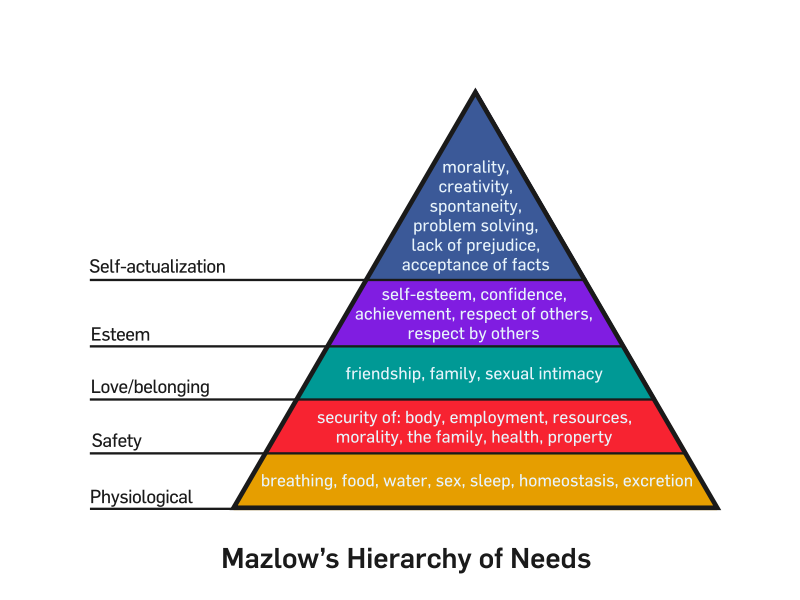
Taking into consideration Mazlow's Hierachy of Needs this song clearly fits into Esteem but also has roots in the Love and Belonging level. One could also consider it as 'continuity of self' and 'maintenance of pride' in Chochinov's Dignity Conserving Perspectives model. (free full text) For the patient with a potential life-altering illness it is difficult to consider being able to 'accept facts' under self actualization if everything in the medical system is designed to dehumanize you one interaction at a time.
The obvious dehumanizing example in the hospital is defining patients not by their name but by age, gender and illness and location as in: "the 54 year old female with lung cancer in the ICU." In addition the gigabytes of data, text and images which define a patient via their ever expanding medical chart (paper or digital) serve a similar dehumanizing role.
Two questions I find very helpful in making a stronger connection with patients include asking about name preference and correct name pronunciation. "Do you like/prefer to be called ______?" "What do your friends call you?" are two easy ways to address name preference. Even if it is classically a term of affection like 'Doll'* or a family relation like 'Gramps' if that is the patients preference even for staff to address them I go with it. (*except when it is not a term they choose themselves - see Elderspeak below)
Correct name pronunciation is probably one of my biggest social pet peeves in medical care today. It flabbergasts me to find highly skilled and well educated professionals stop short of pronouncing a potentially difficult name; often times it may come from a culture different than the majority of staff. If you are going to take a patient for a cholejejunostomy, colonoscopy, phlebotomy, computerized tomography, sunitinib or a palliative extubation you can surely spend 30 seconds to understand how to correctly pronounce their name be it Lee Thi Nguyen or Wilhelmina Van Rijn (not patients of mine)
Another aspect is the singer's identification of personality which also is easily reframed to a patient navigating a complex illness. How the medical system views a patient maybe 'she's quiet' but to the person with the illness she may consider herself in better times 'a riot.'
And lastly the refrain "Are you calling me darling? Are you calling me bird?" resonates with current research in geriatrics demonstrating the use of Elderspeak has a demoralizing effect in geriatric patients. Although calling a patient 'darling,' 'doll' or 'bird' may seem endearing it too becomes another way to dehumanize and individual by tagging them with a generic nickname.
I have left a few other gems in the lyrics for you to interpret on your own. Tell me if you hear some of the same themes when you listen to "That's Not My Name."
"That's Not My Name" by The Ting Tings (Columbia Records UK-2008)
Lyrics:
Four little words just to get me along
It's a difficulty and I'm biting on my tongue and I
I keep stalling, keeping me together
People around gotta find something to say now
Holding back, everyday the same
Don't wanna be a loner
Listen to me, oh no
I never say anything at all
But with nothing to consider they forget my name
(ame, ame, ame)
They call me 'hell'
They call me 'Stacey'
They call me 'her'
They call me 'Jane'
That's not my name
That's not my name
That's not my name
That's not my name
They call me 'quiet'
But I'm a riot
Mary-Jo-Lisa
Always the same
That's not my name
That's not my name
That's not my name
That's not my name
I miss the catch if they through me the ball
I'm the last kid standing up against the wall
Keep up, falling, these heels they keep me boring
Getting glammed up and sitting on the fence now
So alone all the time at night
Lock myself away
Listen to me, Oh nah.
Although I'm dressed up, out and all with
Everything considered they forget my name
(ame, ame, ame)
Male background singing:
Song was my in my head and now its in my mind
call the preacher, get some words and get some time
You know I realized. I cannot emphasize
Sitting around with just a promise, nothing binding
Whatever, can't you see? Living so desperately
Standing and choking like a vocal one-liner
Instead of sing-along this song is monotone
I gotta get some soul. I gotta get some feeling
They call me 'hell'
They call me 'Stacey'
They call me 'her'
They call me 'Jane'
That's not my name
That's not my name
That's not my name
That's not my name
They call me 'quiet'
But I'm a riot
Mary-Jo-Lisa
Always the same
That's not my name
That's not my name
That's not my name
That's not my name
Are you calling me darling?
Are you calling me bird?
Are you calling me darling?
Are you calling me bird?
 Williams KN, Herman R, Gajewski B, & Wilson K (2009). Elderspeak communication: impact on dementia care. American journal of Alzheimer's disease and other dementias, 24 (1), 11-20 PMID: 18591210
Monday, September 28, 2009 0
Monday, August 4, 2008
 In 1995, American artist William Utermohlen was diagnosed with Alzheimer's. In an interview, Utermohlen's wife commented, “From that moment on, he began to try to understand it by painting himself.” He began a series of self-portraits that demonstrate not only the physical effects of the dementia on his brain, but also how he saw himself through the eyes of his illness.
The first self-portrait was done in 1967, while he was healthy. The other three were done after his diagnosis.
As his disease progresses, you can see how his artwork has less fine details. The lines are more  blurred. In the second photo, Utermohlen's face is greyed, maybe showing what he felt was going on in his mind. Like there is a shadow cast over his face.
Later in his disease, his image
 becomes more and more distorted and abstract. His images also become more flat. They definitely lack the depth seen in the first.
In the third, he seems to focus on certain facial attributes, like his ear and nose. His eyes seem to be more prominent than in the second. His brow seems furrowed. The background looks almost architectural. Maybe attempting to create a space?
In the last painting, there are very few recognizable features left. The entire image is very abstract. His nose and ear are still somewhat prominent. His eyes are absent or distorted. His mouth is barely penciled in.
Per the New York Times article, William Utermohlen no longer paints. As of the time of the article, he was living in a nursing
 home. An exhibit of his art has been on tour around the world entitled ‘Inside Alzheimer’s: Portraits of the Mind'.
Monday, August 4, 2008 6


