Monday, March 19, 2012
 Araya Rasdjarmrearnsook is an art teacher and one of Thailand's' foremost female artists. She had her first solo show in New York last month with a video exhibition showing historic art history pieces from western culture to rural and religious people in Thailand in an exhibit titled "Two Planets/ Village and Elsewhere"
However, for me, it is her previous work I wanted to touch on for this post. Araya first made headlines in the US with an group exhibit in 1996. More controversy came in late 1990's and early 2000's when her exhibits began incorporating corpses.
In works such as "The Class II" Araya is seen on video lecturing a classroom of corpses. The topic for this lifeless class? Death. You'll see her ask the dead bodies, "Did you die in autumn?" You can see this video on YouTube here. I was struck by the seriousness of her tone as she interacts with the class on a topic they surely must know.
 In "Conversations I, II and III" she meanders through a room of corpses humming. In "This is Our Creations" she actually lies down next to the bodies and is heard saying, "I came here to know you, lying here motionless. Once my father sent me a postcard from very far away. Its sentence: only a still pond can reflect the starts."
My first thought was, what experiences has this woman had with death that has led her to express herself in this way? I had to do much searching to find the answer, but in an interview in 2005 with Oliver Benjamin, she told her story.
 Her father was a physician, and at the age of 3, as her mother labored in childbirth with her father as physician, her mother died. A week later the young sister born also died. In the following 3 years she lost a step sister aged 18 months, her grandmother and great grandmother. As she said in her interview, "From this reason, I guess, I have been interested in examining death"
When you look back, even to her etching "The Dream of Mother" in 1990, you can see the processing of her life events.

Sometime in there, her father then died of cancer. In response, new pieces such as "The Dinner with Cancer I" and "Th Dinner with Cancer II" were done.
Araya has used art as a way to deal with death. Specifically in her words, "I choose art as process of thought for the meaning of death". Araya spoke of that meaning in an interview with Brian Curtin in 2007 saying "In reality, life and death should not be understood as opposites. People deal with death by trying to hide it. They hide death behind ritual or hope to prevent it with medicine. I want people to have more imagination and confront reality!"
In the interview with Oliver Benjamin in 2005 she concluded talking about the topic with, "I'm tired of death! May be too much." That's the goal isn't it? To work with our patients and families to process through it? For now the artist does seem done with death, as her art has moved on to exploration of different ideas.
Whether you are repelled or connected to Araya's work with death, it's what I love about art - a vehicle to express ideas which then stimulate the viewers mind.
To see works listed up until 2002 visit this site. For those 2002 and on visit here.
Oliver Benjamin interview published in Citylife magazine Oct. 2005
Brian Curtin interview published in Art Signal Oct. 2007
Works in order of appearance "Conversation I" (2005), "The Dream of Mother" (1990) and "The Dinner with Cancer I" (1993)
Monday, March 19, 2012 0
Monday, March 12, 2012
 In 2005, artist Christina Symanski fractured her neck diving into a swimming pool. She was pulled out by her boyfriend but has been a quadriplegic since that time.
Symanski continued her art, using her mouth and an iPad. More of her art can be seen here. The effect her injury had on her art is obvious.
She wrote about her experience in her blog, Life; Paralyzed. She also wrote a book about her experience. In April 2011(not posted until December), Symanski wrote a blog post entitled Quality vs. Quantity. In that post, she writes about what quality of life means to her and discusses the importance of having an advanced  directive, how she wished she had had one prior to her accident.
"Because I didn't think things through before hand, or have a living will, I created a very difficult life for myself (unintentionally), by having to live within the confines of paralysis. Living with paralysis (at my level-C4/C5 complete) means I have very few options. In order to stay alive, I HAVE to take medications, accept help from others (for EVERYTHING), and tolerate unbearable (to me) treatments, like having an indwelling catheter, and bowel program. I HAVE to do all of those things, just to survive. That doesn't include coping with the loss of freedom, lack of privacy, loss of sensation, loss of dreams, aspirations and having to deal with constant compromise. It also doesn't account for the physical pain, discomfort, and  sickness, that comes along with living with paralysis, and ultimately autonomic dysreflexia.
I have come to a point in my own life, where I'm struggling with the question "is this life worth living for ME, or am I just prolonging my own suffering?"
It is a very interesting and well thought out post about her life and the decisions she was making.
Christina Symanski's life made headlines when she died on December 1, 2011 after she decided to stop eating in order to end her suffering.
Monday, March 12, 2012 1
Monday, March 5, 2012
 Christian Wiman, editor of Poetry magazine since 2003, was recently interviewed by Bill Moyers about his journey with cancer, falling in love and finding faith in the midst of death. Wiman was diagnosed with Waldenstrom's macroglobulinemia 6 years ago. He's recently undergone a bone marrow transplant and tells Moyers he's in the "wait and see" phase.
As only a poet can do, Wiman's experience of being in danger of dying has allowed him to capture sentiments many of our dying patients may identify with. His latest book of poems, "Every Riven Thing" (Farrar, Straus and Giroux, 2010) captures these moments so artistically that it's easy to resonate with each word.
In the interview with Moyers found here, Wiman reads a poem he wrote while in the hospital. It was right before chemotherapy started, and written in just one day.
It begins, "Love's last urgency/ is earth and grief is all/ gravity and the long fall/ always back to earliest/ hours that exist/ nowhere but in one's brain."
 The poem later ends with "mystery mastering fear,/ so young, standing unstung/ under what survives of sky./ I learned too late how to live./ Child, teach me how to die."
Wiman goes on to talk about the opening line of the poem saying, "I think there's a notion that when you're sick, when you're in danger of dying, that you want to get beyond. You know, you would think you want experience that takes you beyond earth. You want some since of an afterlife or ...beyond. But My experience has been the opposite, that when you feel threatened, what, in fact, you want is the earth. You want concreteness.That's what rescues you."
How profound. I also identified with the concept of going back to "earliest hours that exist", don't we experience this in palliative care? We often counsel families to not be alarmed when hearing a strange story from a loved one. It actually may be a memory that existed, "nowhere but in one's brain."
Besides being confronted with mortality, Wiman has also experienced excruciating pain throughout his disease process and treatment. He said that this even more than the idea of death has impacted him.
An essay he wrote related to pain was published in the Harvard Divinity Bulletin for Winter/Spring 2012 and Wiman read it during the interview. In the words below I am struck with his isolation but also with the final effect of desire for God in the aftermath.
"Six years have passed since I wrote the first words of these notes. I have been in and out of treatment, in and out of the hospital. I have had bones die; joints lock in my face and arms and legs so that I could not eat, could not walk; cancer pack[ed] my marrow to the point that it began to expand excruciatingly inside my bones. I ... filled my body with mouse antibodies, small molecules, chemotherapies eating into me like animate acids. I have passed through pain I could never have imagined, pain that seemed to incinerate all my thoughts of God and leave me sitting there in the ashes, alone. I have been islanded even from my wife, though her love was constant, as was mine. I have come back, for now, even hungrier for God, for Christ, for all the difficult bliss of this life I have been given. But there is great weariness too. And fear. And fury."
Thanks to Chris Okon for steering me to the interview. For those, like me, who had not read Christian Wiman's poetry or prose, this will be someone to add to your collection.
Monday, March 5, 2012 0
Monday, February 20, 2012
 I don't really mean to be on a skeleton kick... but was exploring this very old work done by Hans Holbein the Younger in the 1500's, and thought I'd share it.
Holbein, a German artist, was really known in the 16th century as one of the great portraitists of his time. Many of his portraits, such as of Sir Thomas More and Henry VIII are housed in the great museums of the world.
However, at least initially in his career, much of his money was made doing religious commissions. These works were often done as woodcuts for easy reproducible printing. The work I found interesting was his "The Dance of Death" published in 1538.
Experts agree the engravings were done 12 years earlier in 1526, which was very close to the reformation and peasants' rebellions of 1524. These events are reflected in the thematic elements of justice in his work, as well as the top down approach of death's activities. The message is very clear; summed up in the words from the book, "De la Necessite de la Mort qui ne laisse riens estre pardurable" translated "The necessity of death leaves nothing and is eternal". Another way of saying this is, no one will escape death.
 The book consists of a series of 41 woodcuts depicting death as a skeleton robbing people of life in the midst of every day activities. The first 4 woodcuts are regarding Adam and Eve, as if to provide the foundation of death itself. Then symbolically all people are included, starting from the most powerful (the Pope) to the lowliest (a child). Accompanying each etching are Latin quotes based on scripture.
I enjoyed scrolling through the images as they provide a glimpse of societal structure at the time. There are duchesses, emperors, attorneys, doctors, senators, clergy, etc. Holbein is known for his symbolism as well as sarcasm, so many of the pictures depict this. For instance the nun is caught with a lover, as death extinguishes the religious candle. The doctor is depicted with death having brought him a dying patient, as if to mock the doctor's attempts at staving off death.
 Besides this rich body of work, there was a version of this dance of death done as an alphabet by Holbein in 1526 but not published until 1538. The same characters from the book are depicted with letters of the alphabet. Wouldn't this be a nice children's learning tool?
Take some time to scroll through the work in entirety on the Project Gutenberg site. This other web site has the alphabet and contrasts each letter to the referenced Dance of Death book image.
Monday, February 20, 2012 3
Friday, February 3, 2012
 |
| by Elliot Bennett |
"I am creating these photographs to gain a deeper understanding about what it means to be mortal and to exorcise my fears of aging. I have come to realize that these images are self-portraits, or at the very least, they are manifestations of my fears and hopes about what I will be like when I am old. My intention is to take an honest and unflinching look at old age and I want these images to inspire others to become aware of and to engage with their own attitudes toward aging and mortality." - Isa Leshko
Both the photos and the movie about Isa are worth a look.
Friday, February 3, 2012 0
Monday, January 30, 2012
 Art collector Richard Harris, while visiting an art fair in 2001 in the Netherlands about the inevitability of death, had an epiphany of sorts. Why not start collecting art that deals with death as its theme? More than a decade later Harris now owns over 1500 pieces of art and artifacts that deal with the subject of death. I think Harris should be an honorary pallimed member, since our mission has been to explore all things art and humanities, related to the subject of death.
 Harris's art works are really a Memento Mori or "remember you will die" collection. The representation of death is that of a skeleton, rather than a depiction of the process of dying itself. The symbolism still invites the viewer to examine death and contemplate mortality, while still being somewhat removed. Harris, age 74, told an interviewer that the collection also provides him with inspiration, he said that, "before I do die, before death does come to me...I should put together something of an overall view of death from my perspective."
 The collection spans over 6,000 years in time, with historical as well as contemporary works. There are artifacts and photographs and cultural materials all exploring death. Starting January 28 and running through July 8 some of Harris's massive collection will be displayed at the Chicago Cultural Center in an exhibit entitled, "Morbid Curiosity: The Richard Harris Collection"
To read more about the exhibit and learn more about Richard Harris visit the Chicago Cultural Center. To see a few more images of his collection go here.
All images are part of the Richard Harris Collection.
Monday, January 30, 2012 1
Monday, January 23, 2012
 Thanks to Drew Rosielle who sent me a link to this video game. I am not big on playing video games. I figure one person in our household (my husband) being obsessed with them is enough. There's just too much action for me, and my lack of hand-eye coordination prevents me from ever being successful when I have tried. This game, To the Moon, is a different type of game and fits right in with other Pallimed topics.
To the Moon is an "indie adventure RPG". (My husband tells me that RPG means role playing game.) In this world, there is a procedure that physicians can do in which they go back into a patient's mind and implant a new memory, thereby giving someone their fondest wish. Or really the false memory of having gotten their fondest wish. The procedure is very risky as pre-existing memories can conflict with the newly planted ones. They only ever do this when someone is on their death bed.
"And if all goes well, they would wake up, having lived the dream life they never had, and embrace a brief moment of blissful fulfillment. Shortly after, they’d draw their last breath."
This game follows Dr. Rosalene and Dr. Watts as they work their way back through the memories of an elderly man, Johnny. The new memories have to be implanted in childhood. Each of Johnny's memories they go through is an interactive scene. Through the memories they try to figure out why Johnny chose this specific wish, to go to the moon.
Below is a trailer for the game.
How horrible is it that one of my first thoughts was that insurance totally wouldn't pay for this.
It sounds like a sweet and interesting game. How interesting would it be to be able to go back through the memories of my patients and see what really motivated them in life and what shaped their dreams. Kind of A Christmas Carol-esque but in third person instead of first.
I haven't had the opportunity to attempt to play it yet but you can purchase it on their website or just download a sample. The game also has a beautiful original soundtrack. Below is the main song, but many of the songs can be heard here.
Thanks again Drew. This was a great find.
Monday, January 23, 2012 0
Monday, January 9, 2012
I am often drawn to artists who have experienced death and then use their work to process the loss. Julie Williams is just such a person. She is an Australian photo-artist, who in 2004 lost her partner. In an effort to work through her grief, Williams began to visit familiar places in nature. One spot she kept returning to, was a waterhole in the Hartley Valley. It seemed that as a drought back in 2004 the valley ended, and the River Lett began to flow again, her grief also moved with it. She picked up her camera and began to photograph the water, the light, and the movement.

 Each time she returned over the next weeks, months and then years, the waterhole was different. A metaphor for her journey, that grief seems to change moment by moment, just as the water flow changed. The subject matter itself, being water, is somewhat symbolic of grief - as we think of tears being shed, of streams down someone's cheeks. Williams herself has pointed out that even the images, elusive and inexplicable, can be like grief itself.
 These works were on display this fall, entitled "When first knew this place" at the Western Plains Cultural Centre in Dubbo, NSW, Australia. Williams says of the title, "The grief pulled me up, the water drew me in and that was when I began to really see. It was when first I knew this place." When asked about her upcoming plans, Williams told an interviewer that she wasn't done with the waterhole yet, that it continues to keep drawing her back.
Personally, I enjoy seeing images of every day surroundings, portrayed in such a way that they appear magical, moving, or unrecognizable. These images then to me, are aesthetic and mean even more in the context of grief.
To see a complete collection of the artists works, visit her page here.
The above images are "Untitled # 3" and "Untitled # 21", both copyright 2011 Julie Williams
Monday, January 9, 2012 0
Monday, December 26, 2011
 The finale of the reality television show Work of Art: The Next Great Artist aired last week. This show is like a lot of reality shows. The artists are each week given a topic or project to make a work of art. Each week an artist is voted off by a panel of judges. In the finale, the three top artists spent three months creating their solo exhibitions. What I found interesting is that 2 of the 3 shows were partially or
  completely themed around death.
Young Sun, one of the finalists, show was entitled Bool-sa-jo and was focused around the illness and then death of his father. Written on the exhibit was a conversation between Sun and his mother.
"My sweet bool-sa-jo," she called him. Mom stroked Dad's cheek.
"What does that word mean?" I asked.
"Phoenix," she replied. "He's survived so many operations, strokes, chemo.
He keeps living. That's why I call him that. I think he'll live longer than me!"
Finding a balance between closure and remembrance isn't easy.
Bool-sa-jo at once an epilogue and a tribute to the process of loss and healing amongst family"
Kymia Nawabi, the winner of the finale, had an exhibit entitled Not For Long, My Forlorn. Her work focused around life cycles, including death and life after death. Below is a poem at her exhibit and then a video of Kymia talking about her work.
All in that body
Allin your spirit and soul
What of it next?
More glimmer of gold
Look to the Ouroboros
Its beginnings and ends
Sacred scared warrior
Shed your skin again
Onward and all ways
You fight for the grave
Have great faith in yourself
Cosmic paths are paved
So, no for long my forlorn
For the fight in this life is brief
They sheathe each end
With your spirit, never to sleep
The exhibits can be seen on the shows website here.
Monday, December 26, 2011 0
Monday, December 12, 2011
I am a huge fan of Radiolab, and happened to hear their story of the Resusci Anne, or CPR Annie, recently. I thought Pallimed Arts readers would enjoy this as it fits well into our field.

This face is not just a plastic computer generated face either. There is a unique history to Resusci Anne. The designer of Annie is Asmund Laerdal, a Norwegian toy maker. Laedral agreed to participate in this new training idea when friend Dr. Peter Safar, the father of CPR, asked. Laedral, however, needed inspiration and so while visiting his parents he noticed an attractive mask of a woman's face on their wall and knew immediately this would be his model. The face he saw was actually a death mask, known as "L'Inconnue de la Seine"
If you need a refresher on Death Masks, Amber talked about it in a post a while ago. They are plaster casts made of someone's face, soon after death, used as a memento.
 "L'Inconnue de la Seine" actually means the 'unknown woman of the Seine'. The story goes that this beautiful woman was pulled out of the river Seine in Paris in the 1880's. Her beauty struck the workers at the morgue, so a death mask was created. The reason for her death was guessed to be suicide and from there her legend grew. In time reproductions were created and people captivated by her unknown identity and beauty began to display the mask in their homes as art.
 Her identity to this day is unknown, but this has not stopped her allure. She was a bit of a sensation, especially in the 1920's and 30's, and well known writers such as Richard le Gallienne, Jules Supervielle, Claire Goll and Anias Nin mentioned L'Inconnue in their works.
The Radiolab episode commented on the irony of this whole story. The unknown beautiful lady who drowned, is now symbolically resuscitated in CPR classes around the world, over and over again.
I found a deeper irony in my research. Both Peter Safar and Asmund Laerdal had children who required resuscitation. Asmund's son nearly drowned in 1954 at the age of 2, and his Asmund, despite not knowing CPR, was able to revive him. Dr. Safar had a daughter with severe asthma, who had a tragic asthma attack in 1966. Dr. Safar was able to resuscitate her with CPR, however she had anoxic trauma and died several days later.
I would highly recommend a listen to Radiolab's piece, as they interview Laerdal's son and do a superb job telling this story. Most of all, the next time you do CPR training, remember the story of the "L'Inconnue de la Seine" as you do your, "Annie, Annie, are you okay?"
Monday, December 12, 2011 1
Monday, December 5, 2011
 We have done posts that featured unusual cemeteries in the past. I've heard people make comments about where they would want to be buried or the cemetery or plot they picked out. As Amy pointed out in her post, most people pick out there cemetery based on family reasons. A recent NPR story, highlighted a very interesting kind of cemetery for those who choose their cemetery based on their favorite hobby. Sunset Hills Memorial Park in Bellevue, Washington has created a Memorial Golf Park.
The Memorial Golf Park isn't an entire golf course. It is one complete hole including a tee-box, 820-square-foot green, fairway and sand trap. It's the first of its kind.
The concept was developed by Arne Swanson, the market director for the park and a golfer himself. He apparently got the idea when he saw a group of golfers spreading ashes at the golf course. "My thought was that there were likely other golfers who would like to be memorialized amid the surroundings of a verdant, peaceful golf course." He also liked that it would give the families a place they could visit to remember their loved one, not just a random spot in the middle of a public golf course.
As the NPR story pointed out, it seems unlikely this trend will pick up amongst other sports (a tennis player under a tennis court etc.) But it did get me thinking. If you could design your own special cemetery, what would it be?
Thanks to Thomas Quinn who sent me the link to this story.
Monday, December 5, 2011 0
Monday, November 21, 2011
 I recently came across an educational computer game called "The End". The game was developed by UK broadcaster Channel 4, specifically their C4 education branch. Channel 4 commissioned the software developer Preloaded to write the program, geared specifically to 14-19 year olds. The game also just earned a BIMA Award for "Best Game" this month.
The producer Charles Batho says, "The End sets out to level the playing field, presenting a variety of views about life and mortality from famous thinkers of our time. It's not a non-religious game, just philosophical"
 I found it interesting that in designing the game, the producers actually interviewed 14 - 19 year olds, asking them about death, even having them draw out their ideal funeral.
The game starts after you design your own character. In the first moments in suburbia, a meteor falls from the sky and your character is whisked into the afterlife. There are several objectives at hand, as you explore 3 different worlds. First is to collect "death objects", you do this by playing logic games at the end of each level. There are also quotes about death and living by famous people interspersed throughout the level.
The level itself is peaceful. The character walks and jumps around collecting stars and light. No worries if you fall off a cliff, your character is already dead, so you get as many re-trys as you want.
 A sub theme to this game is self identity. There are yes/no questions in each level that you must answer. These questions are purely personality driven, for example, "Is it possible to be happy simply living in the moment?" and "Would you still be yourself if your mind was put into another body?"
Each question you answer gives a more accurate plotting on something called the Death Dial. This aligns your personality with other famous thinkers. These questions then become a conversation piece as those who play the game can ask others what their philosophy is.
The best news- the game is free. You can play it this moment at http://playtheend.com/game
For such a heavy topic the developers did a good job making something approachable, fun, and slipping in a little philosophy as well.
Monday, November 21, 2011 0
Monday, November 14, 2011
Buried in the middle of Pink Floyd's album, The Dark Side of the Moon, I never really paid a lot of attention to this song, The Great Gig in the Sky. I actually always thought it was a bit strange. It has very few words and these are difficult to understand. The only lyrics are spoken:
"And I am not frightened of dying. Any time will do, I don't mind. Why should I be frightened of dying? There's no reason for it — you've got to go sometime."
Near the end of the song (around 3:30), spoken very, very quietly: "I never said I was frightened of dying." Although song lore states that it is actually "if you hear this whispering, your dying".
The remainder of the song consists of a woman, Clare Tory, wailing to the music.
The song initially started out as organ music accompanied by Bible verses and passages from religious speeches. This earlier version was called "The Mortality Sequence". When they recorded the song, they changed the organ music to piano and worked with various types of sounds for the main "lyrics" such as NASA communications. They finally decided to go with the wailing.
So other than the title, how is this song about death? When Richard Wright was initially writing the sequence, he wasn't thinking death. Some pointed out that the song starts out slow, gets loud and angry then drifts off and this has been compared to death. (I haven't seen a lot of deaths that start out slow then get angry, but the drifting off I can see.) Some have compared the wailing to crying, grief, mourning. Others feel the wailing is supposed to be full of fear, terror. I guess that would refer back to the fear of dying lines spoken at the beginning of the song.
Monday, November 14, 2011 0
Monday, October 31, 2011


Even more broad, this year I decided to just find some great pumpkin art. Using skeleton's as a theme, this is a compilation of pumpkin skeleton carvings. If you've procrastinated this year and need some ideas, perhaps one of these will interest you.
In an effort to provide something educational, does everyone know the history of carving pumpkins?
 This tradition stems from folklore told in Ireland, Scotland and England. The tale goes that a man by the name of "Stingy Jack" tricked the Devil into promising not to take his soul when he died. The nature of these tricks varies from region to region. In one story, Jack carved a cross in a tree the devil had climbed, trapping him until the promise was made. Jack ultimately dies and because of his orneriness is not allowed into Heaven. The devil holds his bargain as well, not allowing Jack into Hell. He's left to wander the earth as a soul. Jack begs for a light as he wanders, and the Devil kindly tosses him an eternal ember from Hell. Jack then carves a lantern out of a turnip for the light. He henceforth becomes known as Jack of the Lantern... or Jack -O-Lantern. The lantern became a part of rural superstition, as carved faces in the lantern were meant to ward off evil spirits as one walked in the dark. The lanterns were then placed on porches to guard the house overnight. On the left is an example of a traditional carved turnip lantern.
.
As people from the British Isles immigrated to the US, their autumn traditions continued, however instead of turnips, they used the more abundant and larger pumpkins. As time went by the carved pumpkin became associated with the Halloween holiday. Now, as the pictures suggest, this creative decor has evolved into elaborate creations!


Monday, October 31, 2011 1
Monday, October 24, 2011
 No, it's not an virtual autopsy. When I first heard the name of this internet company, that was my first guess. Written on the main page of their website is the message "Build your Immortality because Life is worth it". This is a new company which specializes in the "long term preservation of the digital memory of deceased people." Their claim is that their two web applications are "destined to change forever the way people deal with Death." That's a lot to live up to (pun intended).
I-Postmortem recently released I-Memorial.com and I-Tomb.net. I-Memorial is site that allows you to build your own memorial. One can post last messages to family, leave funeral instructions and last wishes. You can actually put up digital copies of wills, insurances policies etc. and have them sent to specific loved ones at the time of your demise.
I-Tomb is meant to be a virtual cemetery of sorts. Family members can put up videos, audio files and written messages in memory of the deceased. A family can just set up an I-Tomb or the I-Tomb can come from an I-Memorial account. How I understood it is that an I-Memorial becomes an I-Tomb once the author has passed. Prior to death the author designates someone to declare them dead (a "Death Declarator"). After declared dead, the personalized messages are sent out to the proper recipients or posted to the I-Tomb, whatever the author specified. The site specifically states that the switch over is irreversible, so I guess make sure someone is really dead before declaring.
This does come at a cost, but not too bad. An I-Memorial account is $120 per year and an I-Tomb is $50 per year. But you can plan ahead and prepay for up to 20 years in advance.
I don't know that this is destined to change how we deal with death but it does seem interesting. The I-Memorial is a bit Type A personality for me. I'm just not that much of a planner. I'm more interested in the I-Tomb/virtual cemetery concept. That is something I can actually see myself doing for a loved one.
Monday, October 24, 2011 0
Monday, October 10, 2011


 Yamamoto was in art school in 1996 when his 24 year old sister died, just two years after her diagnosis of brain cancer. Immediately he began to use art as a way to deal with his grief. His exploration led him to the medium of salt, which is a part of the death ritual in Japan. At the end of funerals, mourners are handed salt to sprinkle on themselves as a way to ward of evil spirits.
Not only is salt a funeral ritual, it is also allows his masterpieces to be impermanent. When the exhibit is finished, the piece is destroyed, and visitors are encouraged to take some salt and place it back in the sea. Symbolic, I think, of human life; a masterpiece that must come to an end, and the body returned back to the elements from which it was formed.
To create the works, Yamamoto uses a simple plastic bottle, often taking 50 hours or more to complete. The amount of salt used is expansive, in the range of 2000 pounds and up.
 When you look at his installations, it is obvious that the process is tedious and time consuming. This too is intentional, as Yamamoto said in an interview with the Japan Times, "I draw with a wish that, through each line, I am led to a memory of my sister... That is always at the bottom of my work. Each cell-like part, to me, is a memory of her that I call up"
I find the work breathtaking in both the intricacy and the overall finished project.
To see a video of Yamamoto at work see below or follow this link.
Monday, October 10, 2011 0
Monday, October 3, 2011
 At a recent event, I had the opportunity to watch the documentary, You Just Have to Laugh. This comedic documentary was appropriately put together by a comedian, David Naster. The impetus behind making the film was apparently a show Naster did in a church in Kansas. Afterward, a man came up and thanked Naster, saying that it had been the first time he had laughed since his son had died.
From there, Naster began exploring the topic of how we use laughter to get through the tough times. In his documentary, he interviews many different people in difficult situations, such as a gentleman with MS, a firefighter who was severely burned, people with tourettes syndrome. One interview was of a psychiatrist with a stutter talking about his experiences working a suicide hotline. Another is of a concentration camp survivor talking about the humor they found in the most horrible tasks. (The documentary points out that we may not find all these experiences funny but if it helps one cope with such a horrible situation, it was funny to them.)
Below is a video clip of Naster talking about his philosophy on laughter and death. Working on a hospice team, this really struck a cord with me.
Naster has also written books on this topic, the most recent Is there Laugh after Death? looks at stories of hospice workers and families of dying patients.
While I don't think Naster's documentary is widely available, it appears to be available at his website.
Monday, October 3, 2011 1
Monday, September 19, 2011

This photographic project was instigated by the The Straits Times, a leading Singapore newspaper, who partnered with the philanthropic Lien Foundation. Eight professional photographers captured 23 subjects in their outfit of choice for burial.
Most burial outfits are favorite clothing picked out by a patient just prior to death, or very often picked by family members. The idea traditionally is not about creativity, but respectful formal wear.
The thought from the Last Outfit project was, what if this were changed? What if our final outfit was a statement about who we are? This personal flare is quite obvious in the photographs taken. Lee Poh Wah, CEO of the Lien Foundation says, "Each exit outfit is one that best expresses the subjects' unique life. Their outfits and candid attitude have given us a fresh and fun perspective on how to deal with death. If there's something like funeral fashion,they are setting a trend by wearing their souls on their sleeves"
One of the subjects actually was on hospice for this project. Madam Foo Piao Lin had cancer and took her role more seriously. She chose an expensive cheongsam, which she had never owned, for her final outfit. She has since passed, byt her wish was fulfilled as she was buried in her cheongsam. She is pictured in the middle photograph in the series at the bottom.
The photographs are definitely conversation starters. I wonder, though, if faced with death like Madam Foo, if indeed these same outfits would be chosen.
What do you think? To those involved in hospice, how often is the last outfit actually brought up or discussed? Do you like the idea of creativity in a burial outfit or is it too much?
To scroll through the 23 images and read short bio's of the participants visit The Last Outfit web page.

Monday, September 19, 2011 2
Monday, September 12, 2011
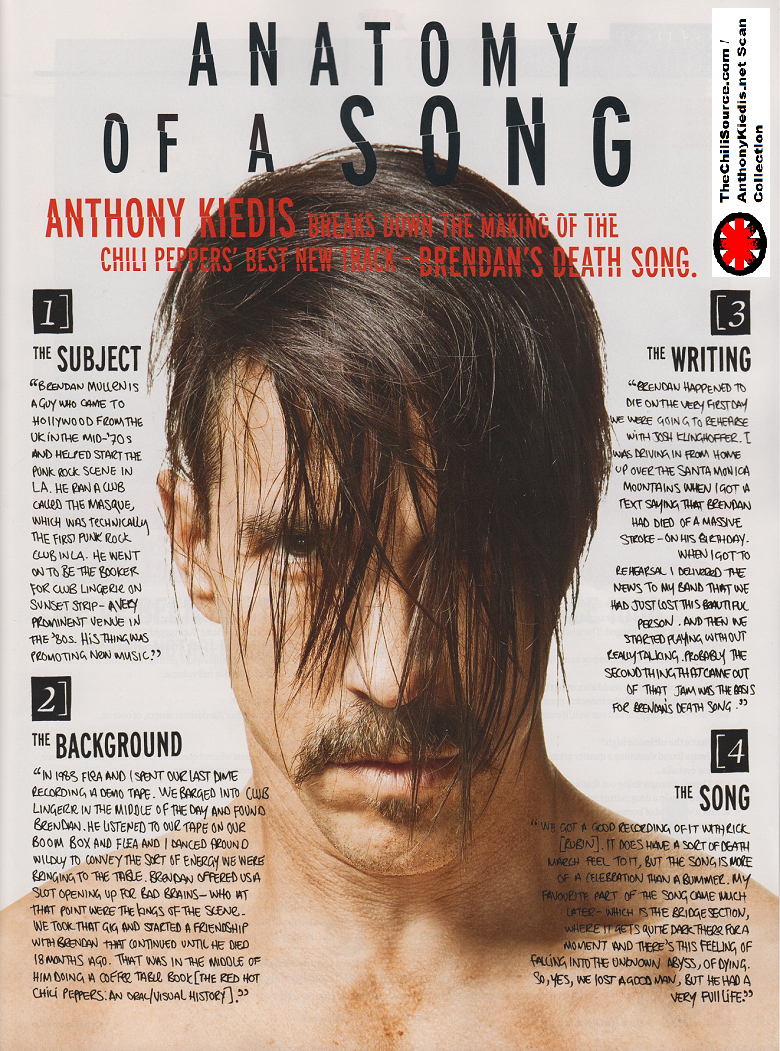
 When I was listening to the newest Red Hot Chili Pepper album, I'm with You, I discovered the song "Brendan's Death Song". The interesting lyrics really caught my attention. "Let me live, so when it's time to die, even the Reaper cries. Let me die so when it's time to live another sun will rise."
Brendan Mullen was a nightclub owner in LA. The Red Hot Chili Peppers credit him with giving the band their start. He was a friend to the band for many years and died in 2009, shortly after his 60th birthday, of a massive stroke.
The day the band found out about his death was the first day of rehearsal with their new guitarist Josh Klinghoffer. From lead singer Anthony Kiedis, "When I got to rehearsal I delivered the news to my band that we had lost this beautiful person. And then we started playing without really talking. Probably the second thing that came out of that jam was the basis for Brendan's Death Song." Kiedis goes on to say that while the song does sound like a death march, they mean it to be a celebration. "My favorite part of the song came much later-which is the bridge section, where it gets quite dark for a moment and there's this feeling of falling into the unknown abyss of dying. So, yes, we lost of good man, but he had a very full life."
Well if I die before I get it done will you decide?
Take my words and turn them into signs they will survive,
Because a long time ago I knew not to deprive.
It's safe out there now your every where just like the sky,
And you are love, you are the lucid dream you are the ride
And when you hear this you know it's your jam it's your good bye
Like I said you know I'm almost dead, you know I'm almost gone
And when the drummer drums he's gonna play my song to carry me along
Like I said you know I'm almost dead, you know I'm almost gone
And when the boatman comes to ferry me away to where we all belong
We all cross when we were feeling lost it's just the time.
Kateri cried the day her lover died, she recognized,
Because you gave her a life of real love it's no surprise.
The nights are long but the years are short when you're alive,
Way back when will never be again it was a time.
It's gonna catch you so glad I met you to walk the line.
Like I said you know I'm almost dead, you know I'm almost gone
And when the drummer drums he's gonna play my song to carry me along
Like I said you know I'm almost dead, you know I'm almost gone
And when the boatman comes to ferry me away to where we all belong
Like I said you know I'm almost dead, you know I'm almost gone,
And when the drummer drums he's gonna play my song to carry me along.
Like I said you know I'm almost dead, you know I'm almost gone,
And when the boatman comes to ferry me away to where we all belong.
Let me live, so when it's time to die, even the Reaper cries.
Let me die so when it's time to live another sun will rise.
Yeah, yeah yeah, yeah yeah
Like I said you know I'm almost dead, you know I'm almost gone
And when the drummer drums he's gonna play my song to carry me along
Like I said you know I'm almost dead, you know I'm almost gone
And when the boatman comes to ferry me away to where we all belong
Like I said you know I'm almost dead, you know I'm almost gone
Like I said you know I'm almost dead, you know I'm almost gone
Like I said you know I'm almost dead, you know I'm almost gone
Monday, September 12, 2011 0
Monday, September 5, 2011
 I came across this inspiring story of artist Casey Shannon. Casey is an artist that lives in Carmel Valley, California. At the age of 36, already a mother, wife and high school art teacher, Casey had a massive left hemispheric stroke. The stroke was debilitating, leaving her aphasic, wheel chair bound and with no use of the right side and little use of her left side.
She writes about the loss of identity and longing for her old self on her website here. As a part of her recovery she learned about Wabi Sabi which is the Japanese tradition of celebrating the beauty in what's flawed or worn. She also turned to art, writing that, "as soon as I could sit for more than just a minute in my wheelchair, I began practicing holding a pencil in my left hand and started doodling and scribbling and such. I intuitively knew that, for me, I needed to get drawing again. And fast, if I was going to save myself"
She ended up drawing 5 pictures a day, having incorporated it into her daily home rehab program. The act of creative expression helped to improve her self-worth and self-esteem.
 It's been 19 years since her stroke, and Casey has regained her speech and the ability to walk, though has lost the use of her dominant right arm. She continues to paint, teach and inspire other stroke survivors with her story.
Casey graciously includes art work on her website from before the stroke, during recovery and current pieces. The first piece above is a sketch done in the year or two prior to her stroke. Her drawings from her recovery period, are taken from about 4 years post stroke. At that point in her process she combined inspirational sayings with her drawings, like the picture to the right.
 As she has recovered, her style completely changed, not only because she now uses her left hand, but because she now does contemporary sumi-e paintings. Sumi-e painting incorporates meditation before painting. As Casey describes on her artist's page, "I concentrate on trying to capture spirit as the ink is transferred to the paper with the stroke of the brush....If your intention is correct, the object in the picture seems to 'breath and take on life'"
I find Casey's story a good reminder of the power art can play with our patients dealing with debilitating disease.
For more of Casey's paintings check out her galleries here.
Monday, September 5, 2011 0