Monday, November 14, 2011
Buried in the middle of Pink Floyd's album, The Dark Side of the Moon, I never really paid a lot of attention to this song, The Great Gig in the Sky. I actually always thought it was a bit strange. It has very few words and these are difficult to understand. The only lyrics are spoken:
"And I am not frightened of dying. Any time will do, I don't mind. Why should I be frightened of dying? There's no reason for it — you've got to go sometime."
Near the end of the song (around 3:30), spoken very, very quietly: "I never said I was frightened of dying." Although song lore states that it is actually "if you hear this whispering, your dying".
The remainder of the song consists of a woman, Clare Tory, wailing to the music.
The song initially started out as organ music accompanied by Bible verses and passages from religious speeches. This earlier version was called "The Mortality Sequence". When they recorded the song, they changed the organ music to piano and worked with various types of sounds for the main "lyrics" such as NASA communications. They finally decided to go with the wailing.
So other than the title, how is this song about death? When Richard Wright was initially writing the sequence, he wasn't thinking death. Some pointed out that the song starts out slow, gets loud and angry then drifts off and this has been compared to death. (I haven't seen a lot of deaths that start out slow then get angry, but the drifting off I can see.) Some have compared the wailing to crying, grief, mourning. Others feel the wailing is supposed to be full of fear, terror. I guess that would refer back to the fear of dying lines spoken at the beginning of the song.
Monday, November 14, 2011 0
Monday, September 12, 2011
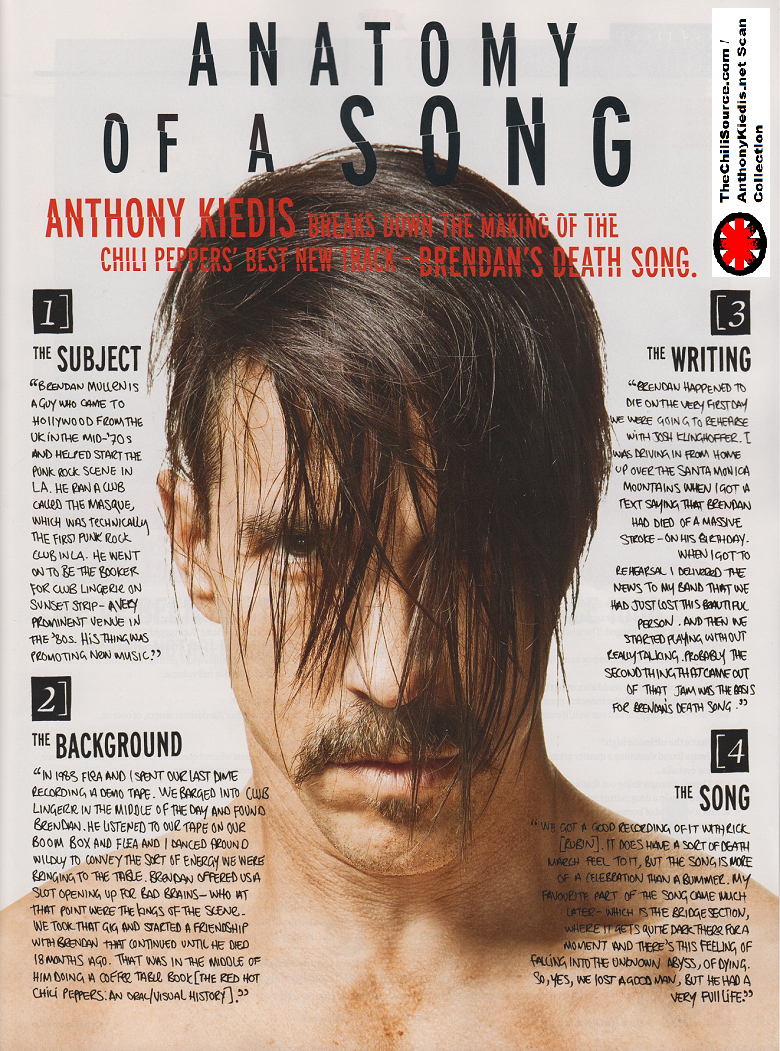
 When I was listening to the newest Red Hot Chili Pepper album, I'm with You, I discovered the song "Brendan's Death Song". The interesting lyrics really caught my attention. "Let me live, so when it's time to die, even the Reaper cries. Let me die so when it's time to live another sun will rise."
Brendan Mullen was a nightclub owner in LA. The Red Hot Chili Peppers credit him with giving the band their start. He was a friend to the band for many years and died in 2009, shortly after his 60th birthday, of a massive stroke.
The day the band found out about his death was the first day of rehearsal with their new guitarist Josh Klinghoffer. From lead singer Anthony Kiedis, "When I got to rehearsal I delivered the news to my band that we had lost this beautiful person. And then we started playing without really talking. Probably the second thing that came out of that jam was the basis for Brendan's Death Song." Kiedis goes on to say that while the song does sound like a death march, they mean it to be a celebration. "My favorite part of the song came much later-which is the bridge section, where it gets quite dark for a moment and there's this feeling of falling into the unknown abyss of dying. So, yes, we lost of good man, but he had a very full life."
Well if I die before I get it done will you decide?
Take my words and turn them into signs they will survive,
Because a long time ago I knew not to deprive.
It's safe out there now your every where just like the sky,
And you are love, you are the lucid dream you are the ride
And when you hear this you know it's your jam it's your good bye
Like I said you know I'm almost dead, you know I'm almost gone
And when the drummer drums he's gonna play my song to carry me along
Like I said you know I'm almost dead, you know I'm almost gone
And when the boatman comes to ferry me away to where we all belong
We all cross when we were feeling lost it's just the time.
Kateri cried the day her lover died, she recognized,
Because you gave her a life of real love it's no surprise.
The nights are long but the years are short when you're alive,
Way back when will never be again it was a time.
It's gonna catch you so glad I met you to walk the line.
Like I said you know I'm almost dead, you know I'm almost gone
And when the drummer drums he's gonna play my song to carry me along
Like I said you know I'm almost dead, you know I'm almost gone
And when the boatman comes to ferry me away to where we all belong
Like I said you know I'm almost dead, you know I'm almost gone,
And when the drummer drums he's gonna play my song to carry me along.
Like I said you know I'm almost dead, you know I'm almost gone,
And when the boatman comes to ferry me away to where we all belong.
Let me live, so when it's time to die, even the Reaper cries.
Let me die so when it's time to live another sun will rise.
Yeah, yeah yeah, yeah yeah
Like I said you know I'm almost dead, you know I'm almost gone
And when the drummer drums he's gonna play my song to carry me along
Like I said you know I'm almost dead, you know I'm almost gone
And when the boatman comes to ferry me away to where we all belong
Like I said you know I'm almost dead, you know I'm almost gone
Like I said you know I'm almost dead, you know I'm almost gone
Like I said you know I'm almost dead, you know I'm almost gone
Monday, September 12, 2011 0
Monday, August 1, 2011
Monday, August 1, 2011 0
Monday, July 25, 2011
I discovered Redemption Song on the Rolling Stone top 500 songs list. It is listed as #66, stuck between #65 Sunshine of Your Love by Cream and #67 Jailhouse Rock by Elvis Presley. I had never heard it before, as I have never been acquainted with Bob Marley's music.
The song Redemption Song is the final song on Bob Marley's album Uprising, the last album that was released during his life time. (One more album, Confrontation, came out after his death.) The lyrics for the song were taken from a speech given by journalist and orator, Marcus Garvey. "We are going to emancipate ourselves from mental slavery because whilst others might free the body, none but ourselves can free the mind."
At the time Marley wrote Redemption Song, he had already been diagnosed with melanoma. He was already dealing with a lot of pain issues and his own mortality. Many consider it to be a sort of summing up of Marley beliefs and it is considered some of his best work.
Marley died in 1981 at age 36.
Old pirates, yes, they rob I;
Sold I to the merchant ships,
Minutes after they took I
From the bottomless pit.
But my hand was made strong
By the hand of the Almighty.
We forward in this generation
Triumphantly.
Won't you help to sing
These songs of freedom?
'Cause all I ever have:
Redemption songs,
Redemption songs.
Emancipate yourselves from mental slavery;
None but ourselves can free our minds.
Have no fear for atomic energy,
'Cause none of them can stop the time.
How long shall they kill our prophets,
While we stand aside and look? Ooh!
Some say it's just a part of it:
We've got to fulfill the Book.
Won't you help to sing
These songs of freedom?
'Cause all I ever have:
Redemption songs,
Redemption songs,
Redemption songs.
Emancipate yourselves from mental slavery;
None but ourselves can free our mind.
Wo! Have no fear for atomic energy,
'Cause none of them-a can-a stop-a the time.
How long shall they kill our prophets,
While we stand aside and look?
Yes, some say it's just a part of it:
We've got to fulfill the book.
Won't you have to sing
These songs of freedom? -
'Cause all I ever had:
Redemption songs -
All I ever had:
Redemption songs:
These songs of freedom,
Songs of freedom.
Monday, July 25, 2011 2
Monday, July 11, 2011
 June 25th, 2011 marked the second anniversary of the death of Michael Jackson. I find it very interesting how iconic celebrities like Jackson are commemorated.
The town of Gary, Indiana, Jackson's boyhood home, has promised a yearly tribute to the King of Pop. This outdoor event includes music, vendors and ends in a candlelight vigil at dusk. It's held at the old Jackson family home. On the first anniversary of his death the city unveiled a monument to Jackson.
Jackson's "Thriller" jacket (the red jacket worn in his Thriller video, seen above) was auctioned off for $1.8 million this year on the June 25th. Apparently a portion of the proceeds will go to the Shambala Preserve, home to Jackson's two Bengal tigers, Thriller and Sabu.
But my absolute favorite way that Jackson was commemorated was various dancing flash mobs. (Flash mobs have made the news a lot lately as there are apparently stealing flash mobs where a group mobs a store and just walks out with merchandise.) These are large groups of people getting together and suddenly breaking into dance. Since his death, these have occurred all over the world from China to Mexico. The video below was taken in Stockholm, Sweden in the weeks after Jackson's death. I found it impressive.
The video below was in San Francisco, this year.
Monday, July 11, 2011 0
Monday, May 2, 2011
 I've been looking for a good blues song to post. I found it in an unusual place. The White Stripes (a rock group) do a cover of the song "Death Letter" (also called "Death Letter Blues". This song was originally performed by American blues singer Eddie James "Son" House. (Apparently House greatly influenced their music and they dedicated their first album to him.)
"Death Letter" is a song about a man who receives a letter that his love has died. He doesn't realize how much he loves her until he sees her being . He goes home grief stricken and missing his love. He then decides he needs to change his way of living so he "don't have to cry no more." I think the death, grief and regret aspects do well sung to the blues.
Interestingly, I found several different lyrics for this song. The ones below don't completely match the song performed below. Apparently House would often change the tempo and lyrics of his songs and would even perform the same song more than once in the same concert. The lyrics are apparently a long version of the song. If you are interested in hearing The White Stripes version, there is a video here which is quite good depending on what you like.
I got a letter this mornin how do you reckon it read?
It said Hurry, hurry, yeah, your love is dead
I got a letter this mornin I say how do you reckon it read?
You know it said Hurry, hurry, how come the gal you love is dead?
So I grabbed up my suitcase and took off down the road
When I got there she was layin on a coolin' board
I grabbed up my suitcase and I said and I took off down the road
I said but when I got there she was already layin on a coolin' board
Well I walked up right close looked down in her face
Said the good ol' gal got to lay here 'til the Judgment Day
I walked up right close and I said I looked down in her face
I said the good ol' gal she got to lay here 'til the Judgment Day
Looked like there was 10 000 people standin' round the buryin' ground
I didn't know I loved her 'til they laid her down
Looked like 10 000 were standin' round the buryin' ground
You know I didn't know I loved her 'til they damn laid her down
Lord have mercy on my wicked soul
I wouldn't mistreat you baby for my weight in gold
I said Lord have mercy on my wicked soul
You know I wouldn't mistreat nobody baby not for my weight in gold
Well I folded up my arms and I slowly walked away
I said Farewell honey, I'll see you on Judgment Day
Ah yeah oh yes I slowly walked away
I said Farewell, farewell, I'll see you on the Judgment Day
You know I went in my room I bowed down to pray
The blues came along and drove my spirit away
I went in my room I said I bowed down to pray
I said the blues came along and drove my spirit away
You know I didn't feel so bad 'til the good ol' sun went down
I didn't have a soul to throw my arms around
I didn't feel so bad 'til the good ol' sun went down
You know I didn't have nobody to throw my arms around
I loved you baby like I love myself
You don't have me you won't have nobody else
I loved you baby better than I did myself
I said now if you don't have me I didn't want you to have nobody else
You know it's hard to love someone that don't love you
Ain't no satisfaction don't care what in the world you do
Yeah it's hard to love someone that don't love you
You know it don't look like satisfaction don't care what in the world you do
Got up this mornin' just about the break of day
A-huggin' the pillow where she used to lay
Got up this mornin' just about the break of day
A-huggin' the pillow where my good gal used to lay
Got up this mornin' feelin' round for my shoes
You know I must-a had them old walkin' blues
Got up this mornin' feelin' round for my shoes
Yeah you know bout that I must-a had them old walkin' blues
You know I cried last night and all the night before
Gotta change my way a livin' so I don't have to cry no more
You know I cried last night and all the night before
Gotta change my way a livin' you see so I don't have to cry no more
Ah hush thought I heard her call my name
If it wasn't so loud and so nice and plain
Ah yeah
Mmmmmm
Well listen whatever you do
This is one thing honey I tried to get along with you
Yes no tellin' what you do
I done everything I could just to try and get along with you
Well the minutes seemed like hours hours they seemed like days
It seemed like my good old gal outta done stopped her low-down ways
Minutes seemed like hours hours they seemed like days
Seems like my good old gal outta done stopped her low-down ways
You know love's a hard ol' fall make you do things you don't wanna do
Love sometimes leaves you feeling sad and blue
You know love's a hard ol' fall make you do things you don't wanna do
Love sometimes make you feel sad and blue
Monday, May 2, 2011 3
Monday, February 21, 2011
 This is a guest post from Eric Holmstrom. (I wasn't able to find a full version of the song to post but you can listen to a sample here.) I had never heard this song before Eric emailed me. It now has an honored position on my playlist. Thanks Eric! And thanks to everyone who sends us great posting ideas.
Monday, February 21, 2011 1
Monday, October 25, 2010
 The rock band Red Hot Chili Peppers was initially formed in 1983 with four members, Anthony Kiedis (vocals), Michael Balzary (aka Flea, bass), Jack Irons (drums), and Hillel Slovak (guitar). In 1988, Hillel Slovak died of a heroine overdose at the age of 26. (Picture to the left is Slovak.)
In the bands recent biography, An Oralivisual History by the Red Hot Chili Peppers, Kiedis (who was also addicted to heroine) talks about the loss. "I denied it and didn't allow myself to feel the true nature of grief and loss until I go out of rehab. I went to visit his grave site, and started speaking to his ghost, and then I realized, 'Oh shit, my partner is gone.'" The loss led Kiedis into rehab. Irons couldn't take staying in the group after his friend died and eventually left.
Slovak was replaced by guitarist John Frusciante and the group has gone on to great success in his absence. In 1991, the group released the album Blood, Sugar, Sex, Magik (which is really their breakout album). One of the songs on this album, "My Lovely Man" was written as a tribute to Slovak.
Even if the Red Hot Chili Peppers aren't your musical style, the lyrics to this song are a very sweet, emotional tribute to a lost friend. The lyrics are fairly self explanatory and are at the end of the post. (FYI, Slim was a nickname for Slovak.)
On a previous album, Mother's Milk, the band released another song "Knock Me Down". Which is was also a tribute to Slovak. One of the lines of the song, "I'm part of you, you're part of me. Why did you go away?"
I used to shout
Across the room to you
And you'd come dancin'
Like a fool
shuffle step
You funky mother
Come to me
All warm as covers
Rest with me
My lovely brother
For you see
There is no other
Memory so sad and sweet
I'll see you soon
Save me a seat
Well I'm cryin'
Now my lovely man
Yes I'm cryin'
Now and no one can
we never fill the
The hole you left my man
I'll see you later
My lovely man if I can
In my room
I'm all alone
Waiting for you
To get home
Listen to Roberta Flack
But I know you won't come back
Well I'm cryin'
Now my lovely man
I'll see you later
My lovely man if I can
Just in case
You never knew
I miss you slim
I love you too
See my heart
It's black and blue
When I die
I will find you
Well I'm cryin'
Now my lovely man
Yes I'm cryin'
Now and no one can
we never fill the
The hole you left my man
I'll see you later
My lovely man if I can
Well I'm cryin'
My lovely man
Well I'm cryin'
My lovely man
I'll see you later
My lovely man
We have some good time
My lovely man
Monday, October 25, 2010 0
Monday, September 13, 2010
I found this song when I was doing research on strange songs people wanted to have at their funerals. I don't know if it's funeral worthy but it is an interesting song. Dead by They Might Be Giants came out on their album Flood in 1990. Dead, like many of their songs is... quirky. (The song is below and you can see the lyrics at the end of the post.)
My initial thought was that it is sung from the point of view of a person who died young or wasn't ready to die-"Accidently taken off the shelf before the date stamped on myself". (Reincarnated as a bag of groceries?) He expresses a lot of regrets about the things he won't ever get to do and wonders how the event (his death) was taken.
After listening to the song a couple times, I changed my view. Maybe it's not someone physically dead but someone who just feels that way. Or maybe he is dead and just lived a life very similar to being dead. "Now it's over I'm dead and I haven't done anything that I want or, I'm still alive and there's nothing I want to do"
They Might Be Giants don't really give a lot of clues as to what they were thinking with their songs. They have on occasion said that some of their songs really don't have a deeper meaning (or even a meaning) to the lyrics but this song seems like it does. Whether they speak of a physical death or more of a spiritual one is open to interpretation.
Dead
I returned a bag of groceries
Accidently taken off the shelf
Before the expiration date
I came back as a bag of groceries
Accidently taken off the shelf
Before the date stamped on myself
Did a large procession wave their (Did a)
Torches as my head fell in the basket, (large pro-)
And was everybody dancing on the casket? (cession dance?)
Now it's over I'm dead and I haven't done anything that I want (now it's over)
Or, I'm still alive and there's nothing I want to do
I will never say the word
"Procrastinate" again; I'll never
See myself in the mirror with my eyes closed
I didn't apologize for
When I was eight and I made my younger brother
Have to be my personal slave
Did a large procession wave their (Did a)
Torches as my head fell in the basket, (large pro-)
And was everybody dancing on the casket? (cession dance?)
Now it's over I'm dead and I haven't done anything that I want (now it's over)
Or, I'm still alive and there's nothing I want to do
(So) So I won't
(Sit) sit at home
(And) anymore
(And) and you won't
(And) see my head in
(And) the window
(And) and I won't
(And) be around
(And) ever anymore
(And) and I'll be up there on the wall at the store
I returned a bag of groceries
Accidently taken off the shelf
Before the expiration date
I came back as a bag of groceries
Accidently taken off the shelf
Before the date stamped on myself
Did a large procession wave their (Did a)
Torches as my head fell in the basket, (large pro-)
And was everybody dancing on the casket? (cession dance?)
Now it's over I'm dead and I haven't done anything that I want (now it's over)
Or, I'm still alive and there's nothing I want to do
Now it's over I'm dead and I haven't done anything that I want (now it's over)
Or, I'm still alive and there's nothing I want to do
Monday, September 13, 2010 2
Monday, September 6, 2010
 I know Christian has mentioned before having ah-ha moments when listening to songs and finally really "hearing" the lyrics. This happened to me this week as I had the children's music writer/singer Justin Roberts on. On one of the slower songs on his album "Meltdown" (2006) I suddenly heard words that I realized were talking about dying.
Justin Roberts -web- -Facebook- -Twitter @MusicianJustin- -YouTube-
Monday, September 6, 2010 2
Monday, August 30, 2010
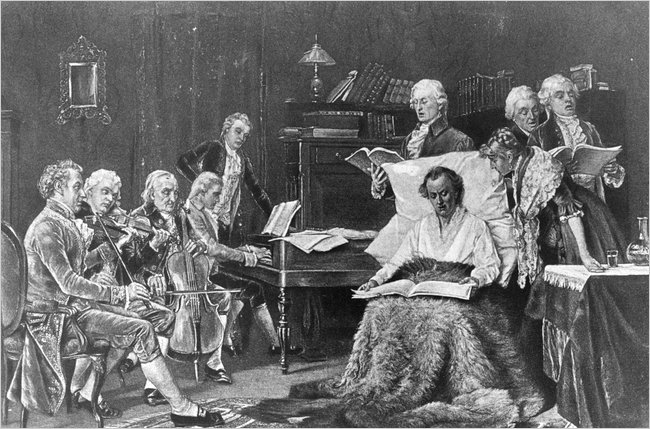 On November 20th 1791 Wolfgang Amadeus Mozart became bed bound. He began to have swelling in his hands and feet. He became listless and began to have fever and vomiting. On December 4th, a group of friends came to perform parts of the Requiem for him. His condition worsened through the night. On December 5th Mozart died at age 35. (Sounds like an episode of House.) He was officially diagnosed by his physician as having had miliary fever (which is apparently a catch all diagnosis for a fever with a rash). His body was buried in a common grave. Soon after his death the speculation as to the exact cause began. A recent New York Times article delves into the medical mystery surrounding the death of Mozart. (The painting is “Mozart 1756-91 Sings His Requiem,” painted in 1882 by Thomas W. Shields.)
The New York Times article discusses an article published in Medical Problems of Performing Artists. They summarized the known theories and came up with 118 different ones. Mozart himse lf once thought he had been poisoned, so that has been one theory. Others include renal failure from various causes, bacterial endocarditis, and congestive heart failure. Medical malpractice even enters the picture. While Mozart was on his death bed, his physician was sent for at the theatre. He apparently responded that he would be there after the show. (The painting to the left is Hermann Kaulbach's 1872 oil painting "Mozart's last days".)
If you're hungry for more information on this medical mystery, you'll be pleased. A quick Google search revealed a Wikipedia page, an article in the Annals of Internal Medicine, and a Medscape article to name a few. I had no idea there was so much interest in this topic.
To me the bigger question is not what actually killed Mozart, but why so many people care so much. A lot of people have spent a lot of time trying to figure this out. One theory given by the article is that a large proportion of doctors play musical instruments. (Really? They don't cite any studies on this, just mention one doctor who does. Very scientific.) From the article: "The very idea that remarkable individuals who gave life so much beauty could be brought down by ordinary physical ailments, particularly diseases that are now easily treatable, is inherently fascinating. That perception makes people of genius seem closer to us."
I don't really agree that doctors are interested because they play musical instruments and want to feel closer to genius. I think it is more likely that many doctors and others of the medical community like a good mystery. (I met a doctor once who did years of extensive research on the assassination of JFK.) And this is a good medical mystery with actually quite a few first hand accounts that one can sink ones teeth into. We can guess all we want, but given the age of the mystery and the fact that there is no available body, it seems there will never be an answer. Maybe that's really why the medical community enjoys researching this. If we can never solve the mystery for sure, then you can't be wrong.
Monday, August 30, 2010 2
Monday, August 16, 2010
So first a disclaimer. This is entirely my opinion. It is possible that someone may very well think that my least favorite funeral songs are their favorites. (I would love to hear which ones you like/dislike and why.) We have several times done lists of top movies and music we liked, so I figured I would hit on a list of dislikes.
When I was trying to think of why I liked some songs at funerals and not others, there are a few elements of the songs that seemed to sway me. 1. Do I actually like the song (of course)? 2. What is the intent of the song? 3. What thoughts does this song conjure up when I hear it?
These are songs that I have actually heard at funerals. So, in no particular order:
Somewhere Over the Rainbow-I actually do like this song as far as songs go. I don't think it is too emotionally heavy. My issue with it is that every time I hear it I think of Dorothy and the Wicked Witch. And then the next song that pops into my head is... Ding Dong the Witch is Dead. I've heard it at funerals a couple times and it just doesn't put me in a  very funeral mindset.
Memory-I don't particularly like this song, but I dislike it for funerals for a similar reason as the above. Every time I hear it I think of dancing people dressed up as cats. Again, weird mindset for a funeral. Holes in the Floor of Heaven by Steve Wariner-First I'm not a huge country fan but that is not why I don't care for this one. I put this in a group of songs that I consider to be emotional torture. They are the songs that you just know you will get people crying with. If the purpose of a song is to make people more sad and crying, why would you play it at a funeral where people are already sad and crying. (Again, completely my opinion.) If I'm going to cry at a funeral I think it should be for the person who has died, not for the manipulative song.
But in the end, it doesn't really matter what I or anyone else thinks. Writing this post, I looked through a lot of lists of music that are put out as suggestions for funeral songs. Disturbingly, the song my husband and I danced to at our wedding was on a list (Never Tear Us Apart by INXS). I think this just shows that songs take on different meanings to different people. If it gives you peace to play Another Bites the Dust at a loved ones funeral, then I think you should.
Monday, August 16, 2010 14
Monday, August 9, 2010
 I just recently returned from a trip to Papua New Guinea. It is one of my favorite places on earth, and each time I go I encounter something new.


Monday, August 9, 2010 0
Monday, July 19, 2010
 Just a year after his first album was released at age 29, self taught jazz composer and pianist Fred Hersch was diagnosed with HIV. Hersch was recently interviewed on NPR's All Things Considered.
"For at least the first number of albums I made on my own, I really had this kind of dramatic feeling like this is going to be my last statement and I just wanted to create enough of a body of work that if I died I might somehow be remembered. That was like the thrust."
In 2008, Hersch developed an AIDS related delirium. He developed pneumonia and septic shock. He required a feeding a tube. He states he was in a coma for 2 months. When he came out of his coma, he couldn't walk, talk or swallow. He suffered from vocal cord paralysis.
Now 54, Hersch has released more than 2 dozen albums. "...Now that I've been on the scene and achieved some degree of success and respect I don't feel the need to prove my self in any particular way. I can take more risks." He recently released the album Whirl, his first since his prolonged illness.
How did his illness effect his music? "I think in ways I may be better. I feel certainly more relaxed as a player. I think I'm digging deeper. There are a few little technical things that were easier before that now I have to compensate for, but the small technical things, nobody would notice but me."
Below is one of the songs from Whirl, "Still Here". It is not actually about Hersch himself. It was inspired by Wayne Shorter, jazz saxophonist and composer who is still playing and composing at age 76. (A couple more of his songs, "Snow is Falling" and "Skipping" can be heard on the NPR website, here.)
I find it amazing that Hersch not only recovered from such a serious illness, he went on to create terrific jazz. When I heard his NPR interview, it stuck in my head because of his interesting outlook on his illness. His health problems didn't hinder his music career. They seemed to spur it on.
Monday, July 19, 2010 1
Monday, June 28, 2010

Scott Joplin is known as "The King of Ragtime", with such famous pieces as Maple Leaf Rag and The Entertainer. Born near Texarkana, Texas in 1867/68, Scott Joplin began playing the piano at age 7, at the homes where his mother cleaned and did laundry.
Ragtime was popular between 1897 and 1918, ironically paralleling Joplin's career. In fact it was the publication of Maple Leaf Rag in 1899 spurred the popular spread of ragtime.
Early in his career, Joplin lived in Sedalia, Missouri. He married Belle Hayden in 1899, the marriage lasting only a few years. Although they had one daughter, she died only a few months after birth.
It was on a trip back to Sedalia, traveling through Arkansas, that he met Freddie Alexander, falling instantly in love. He wrote the piece "The Chrysanthemum"(1904) for her, which many regard as one of his most beautiful pieces. Listen to a bit of this upbeat ragtime song, since we'll contrast it with another piece at the end.
The two were married in June 1904 in Little Rock, Arkansas and took a train back to Sedalia, stopping a few days at a time to play concerts. It took a whole month to travel home and upon reaching Sedalia, Freddie was feverish. What seemed to be the flu, slowly turned to pneumonia and in September 1904, Freddie died. Only married 10 short weeks, Joplin was devastated. He left Sedalia for good after her funeral. In his grief, Joplin wrote "Bethena"(1905). Experts believe that this was in honor of Freddie, and quite the contrast from "The Chrysanthemum" written when he fell in love. On the original publication there is a picture of a woman, which some have even speculated is a picture of Freddie.
I think if you listen to this, you'll hear the grief but also a type of endearment. Ragtime in its nature is not sad or depressing. The ability for Joplin to take such an upbeat genre and still convey sorrow is truly remarkable. I'd heard this piece before, not knowing the background; Context, once again, is everything.
Scott Joplin developed complications from tertiary syphilis in1916, and required admission to Manhattan State Hospital in January 1917 due to a "decent into madness". He died there April 1, 1917.
Monday, June 28, 2010 1
Sunday, June 13, 2010
One of my favorite bands, Nada Surf, recently came out with a new album of covers and to whet my appetite before I could get my hands on some digital mp3's I went back to some of their old albums and listened to them all the way through. One song kept sticking out to me because a few lines really resonated with a convergence of work/family overload I recently experienced. But as I dug out from that overload I started to see the song differently and through the eyes of some of the family members of patients who were dying.
Here is a video of Nada Surf performing "Do It Again" live in a record store (there is no official video and check out the cool drum box the drummer is using, it is called a cajon and is very fun to play!):
The main lyric that first caught my attention was near the end of the song when the energy picks up from the mid tempo relaxed arrangement used for most of the song. The lyric is:
Maybe this weight was a gift / Like I had to see what I could lift
I spend all my energy / Walking upright
Well I'd snap to attention / If I thought that you knew the way
I'd open my mouth / If I had something smart to say /
I bought a stack of books / I didn't read a thing
It's like I'm sitting here / Waiting for birds to sing
- temperance
- passion
- womanhood (China)
- take care of yourself for me
- fragility
You're lying down / And the moon is sideways
And I like the masking noise quiet / Of your breathing nearby
No temptation has seized you except what is common to man. And God is faithful; he will not let you be tempted beyond what you can bear. But when you are tempted, he will also provide a way out so that you can stand up under it.While it mentions temptations and not more specifically trials, you could see the basic sentiment exists that has launched many self-help books. People endure many different hardships throughout their life and eventually most get through it but they have changed, some for good and some for worse. How one emerges from the tough times is up to the individual and their support system, but it may sometimes turn out that 'the weight was a gift.' Just don't tell that too them in the middle of their journey. That is only something that should be self-discovered.
Lyrics: (2005 Barsuk Records - The Weight is a Gift)
Well I'd snap to attention / If I thought that you knew the way
I'd open my mouth / If I had something smart to say
I bought a stack of books / I didn't read a thing
It's like I'm sitting here / Waiting for birds to sing
Let's do it again
Come on let's do it again
Please let's do it again
The hum of the clock / Is a far-away place
The azalea air holding your face / You're lying down
And the moon is sideways / (From the hot to the cold It never gets old)
I spend all my energy / Staying upright
And I like the masking noise quiet / Of your breathing nearby
I want you lazy science / I want some peace
Are you the future? / Show me the keys
When I accelerate / I remember why it's good to be alive / Like a twenty-five cent game
Maybe this weight was a gift / Like I had to see what I could lift
I spend all my energy / Walking upright
Sunday, June 13, 2010 9
Monday, May 24, 2010
 For clinicians looking for medical songs to pull out for discussion, you may want to add this song by French actress and singer Charlotte Gainsbourg. The song, IRM is from her new album of the same name. IRM, the album, was released Jan. 26, 2010 on the Elekra/Asylum label. Co-written, mixed and produced by Beck, the album is described by Michael Katzif from NPR as having "lyrical subtlety and layered details that unspool upon each listen"
The title song, IRM, is the french name for MRI, as in Magnetic Resonance Imaging. The background story is that in 2007 Charlotte had a skiing accident in the states. After the minor accident she began having headaches, and subsequent serial MRI's were preformed. Ultimately she required surgical decompression from a hematoma.
She says that during the MRI procedures, she'd listen to the whirring of the machine thinking what great background it would make for a song. While many of us may hear sounds in our daily lives that we randomly think could fit into a song- she did it. But it's not just background, the lyrics themselves are about the procedure as well. Below are the lyrics and then song:
Take a picture, what's inside?
Ghost image in my mind
Neural pattern like a spider
Capillary to the centre
Hold still and press the button
Looking through a glass onion
Following the x-ray eye
From the cortex to medulla
Analyze EKG
Can you see a memory?
Register all my fear
On a flowchart disappear
Leave my head demagnetized
Tell me where the trauma lies
In the scan of pathogen
Or the shadow of my sin.
Anyone who's had an MRI, or been around them won't have trouble hearing the machine sound. I even think the drum beat has the sound of a tachycardic pulse. The lyrics help contrast so well the impersonal world of medicine with the idea of being human, i.e. "can you see a memory?"
Here's the song from YouTube below.
Monday, May 24, 2010 1
Monday, April 12, 2010
If you attended our talk at the Academy meeting, you will recognize this song. I Don't Want to Die (In the Hospital) by Conor Oberst and the Mystic Valley Band was released in 2008 on his album Conor Oberst. I think it's a fun listen in general and especially for anyone in the hospice and palliative care field. I thought it deserved its own post. Enjoy!
The first thing that strikes me about this song is the upbeat music for such a serious topic. It's not the tone you would expect for talking about how one would like to die. With the same lyrics but different music, it could be a very different song. In an interview with Oberst, he talks about what he was thinking when he wrote this song.
"I think it has a sort of comedic aspect to it. The juxtaposition of the music and what's being sung about I suppose. ... I just think of sort of a stubborn old cowboy man that just wants to go lay in the grass and, you know, die out by the tree or something. "
The comical lyrics make me realize how I take the hospital experience for granted. Horrible gowns, bad TV, small sterile rooms, unable to do the things you enjoy most. Put that way, probably not the setting I would choose to spend my last days in. To some, this would be like a prison.
As the song gets closer to the end, the singer begins to sound more desperate. At one point he changes "I don't want to die in the hospital" to "I don't want to die". His voice sounds a bit crazed at times. Is there some terminal delirium there at the end?
I was just listening to this song again as I write this post and I had a moment. I was remembering several experiences of confused patients in the hospital who just kept getting up trying to leave. (I have even had an experience where the patient was wanting to find his shoes so he could take off.) They just keep say "Help me get up. I've gotta go" over and over. Couldn't say where they wanted to go but just wanted to get out of the hospital. The repetitive lyrics of the song remind me of that. Maybe I should have listened more closely to what they were telling me.
Below are the lyrics to I Don't Want to Die (In the Hospital).
I don’t wanna die in the hospital
No I don’t wanna die in the hospital
No I don’t wanna die in the hospital
You gotta take me back outside
I don’t wanna hear all those factory sounds
Looking like the girl in the sleeping gown
I don’t wanna die in the hospital
You gotta take me back outside
Can you make a sound to distract the nurse
Before I take a ride in that long black hearse
I don’t wanna die in the hospital
You gotta take me back outside
Help me get my boots on
Help me get my boots on
Help me get my boots back on
Help me get my boots on
Help me get my boots on
Help me get my boots back on
I gotta go, go, go
Cause I don’t have long
Yeah I don’t give a damn what those doctors say
I don’t wanna spend another lonesome day
I don’t wanna die in the hospital
You gotta take me back outside
They don’t let you smoke and you can’t get drunk
All there is to watch are these soap operas
I don’t wanna die in the hospital
You gotta take me back outside
Can you get this tube out of my arm
Morphine in my blood like a slow sad song
I don’t wanna die in the hospital
You gotta take me back outside
Help me get my boots on
Help me get my boots on
Help me get my boots back on
Help me get my boots on
Help me get my boots on
Help me get my boots back on
I gotta go go go
Cos I don’t have long
Is there still a world at my windowsill
All there ever was I remember still
I don’t wanna die in the hospital
You gotta take me back outside
Don’t know when it’s day or when its night
All I ever see are florescent lights
I’m not gonna die in this hospital
You gotta take me back outside
They give me all these flowers & big balloons
But I’m not gonna stay in this little room
I’m not gonna die in the hospital
You gotta take me back outside
Are the stars still in the sky
Is that fat moon on the rise
Feel the earth against my feet
As the cold wind calls for me
I ain’t gonna die in the hospital
No I ain’t gonna die in the hospital
No I ain’t gonna die in the hospital
You gotta take me back outside
I ain’t gonna die in the hospital
No I ain’t gonna die in the hospital
No I ain’t gonna die in the hospital
You gotta take me back outside
Monday, April 12, 2010 6
Monday, March 22, 2010
If you ever write a 9 minute song you would hope it would be a good one. There are only a few 9 minute plus songs in my song collection but "The Trapeze Swinger" by Iron and Wine is one that stands out. If you have any familiarity with it you may remember it from the end credit sequence in the moderately memorable movie "In Good Company."
Hypnotically repetitive, I would occasionally put this song on repeat to fall asleep to when I lived alone during my palliative medicine fellowship (and my wife had to be in another city for her fellowship.) At first I took the 'please, remember me' line to be more about my long-distance relationship with my wife, but as I continued to listen to it falling asleep after long days of being surrounded by dying people at the hospice house the meaning clearly evolved.
Since the song is so long go ahead and start listening to it as you read the rest of this post.
Iron and Wine is really a one man band led by Samuel Bean. The simple strong structure repeats through the song with little accents placed on each verse by different instruments or Bean's voice. The back and forth nature of the song structure reminds me of being at the beach watching the waves come crashing in and then slowly recede.
The intro begins with soft wind chimes and what sounds like sea shells or a rain stick followed by the basic guitar melody and a chorus of 'oohhh-ohhhhhs.' As the song advances we hear a ton of different instruments: slide guitar, bass guitar, wood blocks, tom toms, percussive metal, an organ played in reverse, tympani drums, upright bass (around 4:53 - my favorite part!), a song played in reverse, piano, and finally a toy whistle. All of these instruments begin to layer into an increasingly complex sound. I can't imagine being the sound mixer on this song!
The lyrics obviously focus on a theme of rememberence and like the instrumentation the repetitive nature allows for different takes on the same theme. here are the first lines of all the verses laid together.
Please, remember me happilyThe perspective of the dying person wanting to instruct those still alive on how to keep the memory (and the legacy) alive is commonly seen in hospice and palliative care. How we as friends, family or staff enhance or suppress this legacy building is not often talked about as openly as this song manages. How would caring for a person who is dying be different if we spent some time with them asking how they would like to be remembered?
But please, remember me fondly
And please, remember me that Halloween
So please, remember me mistakenly
And please, remember me as in the dream
But please, remember me, my misery
And please, remember me seldomly
So please, remember me finally
There are many religious references in the song, but each of them comes with a little bit of the singer's reality. Imagining the heaven with obscene graffiti, or rushed angels who want to get all the new souls through the door place an potentially unknowable realm in earthly terms.
Overall, Bean gives us a bit of poetry mixed with american folk and indie pop that allows you to discover a little something new with each listen. Please share any lines in this song stand out the most to you.
Lyrics by Iron and Wine (aka Samuel Bean) 2004
Please, remember me happily
By the rosebush laughing
With bruises on my chin, the time when
We counted every black car passing
Your house beneath the hill
And up until someone caught us in the kitchen
With maps, a mountain range, a piggy bank
A vision too removed to mention
But please, remember me fondly
I heard from someone you're still pretty
And then they went on to say
That the pearly gates
Had some eloquent graffiti
Like "We'll meet again" and "Fuck the man"
And "Tell my mother not to worry"
And angels with their great handshakes
Were always done in such a hurry
And please, remember me that Halloween
Making fools of all the neighbors
Our faces painted white
By midnight, we'd forgotten one another
And when the morning came I was ashamed
Only now it seems so silly
That season left the world and then returned
And now you're lit up by the city
So please, remember me mistakenly
In the window of the tallest tower
Calling passers-by but much too high
To see the empty road at happy hour
Gleam and resonate, just like the gates
Around the holy kingdom
With words like "Lost and found" and "Don't look down"
And "Someone save temptation"
And please, remember me as in the dream
We had as rug-burned babies
Among the fallen trees and fast asleep
Aside the lions and the ladies
That called you what you like and even might
Give a gift for your behavior
A fleeting chance to see a trapeze
Swinger high as any savior
But please, remember me, my misery
And how it lost me all I wanted
Those dogs that love the rain and chasing trains
The colored birds above their running
In circles around the well and where it spells
On the wall behind St. Peter
So bright, on cinder gray, in spray paint
"Who the hell can see forever?"
And please, remember me seldomly
In the car behind the carnival
My hand between your knees, you turned from me
And said, "The trapeze act was wonderful
But never meant to last", the clown that passed
Saw me just come up with anger
When it filled with circus dogs, the parking lot
Had an element of danger
So please, remember me finally
And all my uphill clawing
My dear, but if I make the pearly gates
I'll do my best to make a drawing
Of God and Lucifer, a boy and girl
An angel kissing on a sinner
A monkey and a man, a marching band
All around a frightened trapeze swinger
Monday, March 22, 2010 12
Monday, March 15, 2010
 Patti Smith is many things; songwriter, poet, visual artist and now author with her new book "Just Kids" published by ECCO in January 2010.
Her first album, Horses, was released in 1975 and led the way to many more punk rock albums and eventual induction to the Rock and Roll Hall of Fame in 2007. Her book, though, is not the tale of her musical career, but of an important relationship early in her life.
 The book "Just Kids" tells of her relationship with photographer Robert Mapplethorpe, whom Patti met soon after moving to New York in 1967. They were two of a kind, aspiring artists who influenced and pushed each other. The book is a tribute to their unique relationship and something she promised Robert she'd write, the day before he died. Robert died in a hospital in Massachusetts from complications from AIDS March 9, 1989. It took her 20 years to do, but Patti Smith fulfilled her promise to her friend.
Patti writes about the moment of his death in her book, "the phone rang and I rose to answer. It was Robert's youngest brother Edward. He told me that he had given Robert one last kiss for me, as he had promised. I stood motionless, frozen, then slowly, as in a dream returned to my chair. At that moment Tosca began the great aria Vissi D'arte 'I have lived for love, I have lived for art'. I closed my eyes and folded my hands. Providence determined how I would say goodbye."
How symbolic and poignant to have such a great aria like Vissi D'arte not only as a theme to their relationship but playing as she heard of his death as well.
While the book tells the tale of their time together, she wrote a song that was a memorial to him and his death. Robert had green eyes, so she used a little emerald bird as the symbol of him.
The lyrics from Memorial Tribute are as follows:
Little emerald bird wants to fly away
If I cup my hand could I make him stay?
Little emerald soul Little emerald eye
Little emerald soul Must you say goodbye?
All the things that we pursue All that we dream
are composed as nature knew In a feather green
Little emerald bird As you light afar
It is true I heard God is where you are
Little emerald soul Little emerald eye
Little emerald bird We must say goodbye
Unfortunately I couldn't find a recording of this song besides the beginning sung in an interview on NPR's morning edition. To hear a snippet of Patti singing a phrase in the studio, checkout this link, then click on listen to the story. The song is at marker 5:57 of the interview.
Monday, March 15, 2010 0