

Friday, February 3, 2012
 |
| by Elliot Bennett |
"I am creating these photographs to gain a deeper understanding about what it means to be mortal and to exorcise my fears of aging. I have come to realize that these images are self-portraits, or at the very least, they are manifestations of my fears and hopes about what I will be like when I am old. My intention is to take an honest and unflinching look at old age and I want these images to inspire others to become aware of and to engage with their own attitudes toward aging and mortality." - Isa Leshko
Both the photos and the movie about Isa are worth a look.
Friday, February 3, 2012 0
Monday, August 2, 2010
 Penn & Teller: B.S! is a Showtime documentary series. Magicians/comedians Penn and Teller set out, in a comedic way, to debunk various paranormal and pseudoscientific beliefs and common myths. Some of their topics have been ESP, astrology, lie detectors, and organic food. One of the most recent episodes, "Old People", takes on various myths and stereotypes faced by the elderly. It isn't meant to offend (something the show definitely doesn't mind doing), but rather point out how disrespectful American culture is of the elderly.
Myth: There is an "old person smell". They set up an experiment with 3 old and 3 young people and had blindfolded volunteers smell them. The smellers had to determine if the smellee was old or young. They were accurate only 56% of the time. Very scientific evidence against the "old person smell".
Myth: Older people can't drive (or drive poorly or slowly). They featured a 70 year old race car driver. They also pointed out that those in the age group 16-24 are more likely to cause a fatal accidental.
Myth: The elderly don't have sex. They interviewed several members of a retirement community about their active sex lives.
But in the end the show takes a serious turn. The last section deals with a controversial end of life issue, physician assisted suicide, or as they call it aid in dying (pointedly to take the word suicide out of the name). They interviewed a gentleman, Sheldon, with mesothelioma, who wants to be able to end his life when things become intolerable. Despite the fact that Penn and Teller clearly are in favor of aid in dying, they do give some screen time to a doctor who disagrees with them. And they didn't taunt him, much. They specifically recognize that it is complex issue, not just black and white.
One of their guests sums it up nicely at the end. "For us just to sort of say, 'Old people have come and gone. Let's sweep them under the rug,' it would be a terrible mistake of ours as a culture, as human beings. I think its unfair to deny them their essential humanity just because they've lived longer than us. That's insane." I know that in a blog frequented by hospice and palliative care professionals, this is preaching to the choir. But I do think it was an interesting topic for them to take on.
Monday, August 2, 2010 0
Monday, September 28, 2009
The nice thing about art is the ability to interpret a piece from your own perspective based on your life experiences and knowledge. Tonight I will attempt a great feat by turning a song about being left alone and ignored on the dance floor into a reminder of the importance of respect in caring for patients.
The Ting Tings released "That's Not My Name" in 2008 and it quickly spread through MySpace and eventually the UK Charts to become a dance club anthem. The catchy yet slightly bratty lyrics feature a frustrated woman who despises being forgotten and never having anyone identify her as someone of worth. The big bass drum beat and hand claps in the opening verse give the song a cheerleading type quality matched by lead singer Katie White's chanting style of singing.
The dramatic pause of music allows the full weight of the lyrics sink in: "With nothing to consider, they forget my name (ame, ame, ame)" the final words like a pitiful echo chamber resonating the isolation the singer feels.
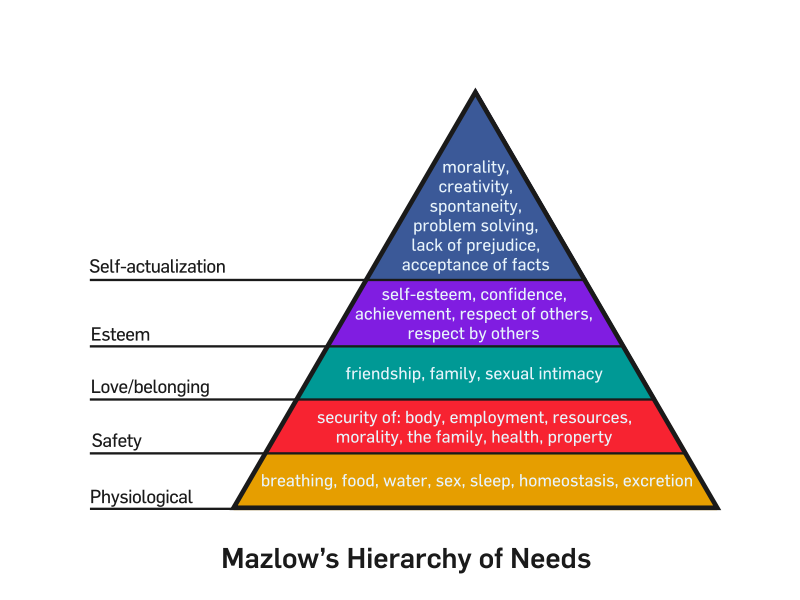
Taking into consideration Mazlow's Hierachy of Needs this song clearly fits into Esteem but also has roots in the Love and Belonging level. One could also consider it as 'continuity of self' and 'maintenance of pride' in Chochinov's Dignity Conserving Perspectives model. (free full text) For the patient with a potential life-altering illness it is difficult to consider being able to 'accept facts' under self actualization if everything in the medical system is designed to dehumanize you one interaction at a time.
The obvious dehumanizing example in the hospital is defining patients not by their name but by age, gender and illness and location as in: "the 54 year old female with lung cancer in the ICU." In addition the gigabytes of data, text and images which define a patient via their ever expanding medical chart (paper or digital) serve a similar dehumanizing role.
Two questions I find very helpful in making a stronger connection with patients include asking about name preference and correct name pronunciation. "Do you like/prefer to be called ______?" "What do your friends call you?" are two easy ways to address name preference. Even if it is classically a term of affection like 'Doll'* or a family relation like 'Gramps' if that is the patients preference even for staff to address them I go with it. (*except when it is not a term they choose themselves - see Elderspeak below)
Correct name pronunciation is probably one of my biggest social pet peeves in medical care today. It flabbergasts me to find highly skilled and well educated professionals stop short of pronouncing a potentially difficult name; often times it may come from a culture different than the majority of staff. If you are going to take a patient for a cholejejunostomy, colonoscopy, phlebotomy, computerized tomography, sunitinib or a palliative extubation you can surely spend 30 seconds to understand how to correctly pronounce their name be it Lee Thi Nguyen or Wilhelmina Van Rijn (not patients of mine)
Another aspect is the singer's identification of personality which also is easily reframed to a patient navigating a complex illness. How the medical system views a patient maybe 'she's quiet' but to the person with the illness she may consider herself in better times 'a riot.'
And lastly the refrain "Are you calling me darling? Are you calling me bird?" resonates with current research in geriatrics demonstrating the use of Elderspeak has a demoralizing effect in geriatric patients. Although calling a patient 'darling,' 'doll' or 'bird' may seem endearing it too becomes another way to dehumanize and individual by tagging them with a generic nickname.
I have left a few other gems in the lyrics for you to interpret on your own. Tell me if you hear some of the same themes when you listen to "That's Not My Name."
"That's Not My Name" by The Ting Tings (Columbia Records UK-2008)
Lyrics:
Four little words just to get me along
It's a difficulty and I'm biting on my tongue and I
I keep stalling, keeping me together
People around gotta find something to say now
Holding back, everyday the same
Don't wanna be a loner
Listen to me, oh no
I never say anything at all
But with nothing to consider they forget my name
(ame, ame, ame)
They call me 'hell'
They call me 'Stacey'
They call me 'her'
They call me 'Jane'
That's not my name
That's not my name
That's not my name
That's not my name
They call me 'quiet'
But I'm a riot
Mary-Jo-Lisa
Always the same
That's not my name
That's not my name
That's not my name
That's not my name
I miss the catch if they through me the ball
I'm the last kid standing up against the wall
Keep up, falling, these heels they keep me boring
Getting glammed up and sitting on the fence now
So alone all the time at night
Lock myself away
Listen to me, Oh nah.
Although I'm dressed up, out and all with
Everything considered they forget my name
(ame, ame, ame)
Male background singing:
Song was my in my head and now its in my mind
call the preacher, get some words and get some time
You know I realized. I cannot emphasize
Sitting around with just a promise, nothing binding
Whatever, can't you see? Living so desperately
Standing and choking like a vocal one-liner
Instead of sing-along this song is monotone
I gotta get some soul. I gotta get some feeling
They call me 'hell'
They call me 'Stacey'
They call me 'her'
They call me 'Jane'
That's not my name
That's not my name
That's not my name
That's not my name
They call me 'quiet'
But I'm a riot
Mary-Jo-Lisa
Always the same
That's not my name
That's not my name
That's not my name
That's not my name
Are you calling me darling?
Are you calling me bird?
Are you calling me darling?
Are you calling me bird?
 Williams KN, Herman R, Gajewski B, & Wilson K (2009). Elderspeak communication: impact on dementia care. American journal of Alzheimer's disease and other dementias, 24 (1), 11-20 PMID: 18591210
Monday, September 28, 2009 0


