Monday, May 21, 2012
This is a unique one, and something I stumbled upon listening to an old podcast from Radiolab produced by NPR.
 There is a town in France, situated in the suburbs of Paris called Garches. The town has a large trauma hospital, Raymond Poincare, where most of the vehicle accidents come to be treated. Unlike other hospitals that have similar amounts of death from chronic disease and trauma, this hospital has mostly trauma related deaths. In fact approximately 450 deaths a year from injuries. The pathologist began to notice that the trauma deaths had a negative impact on the family members ability to grieve. Family members walking into this hospital were in shock, and came to claim the bodies of loved ones who were very much alive the last time they were seen.
Thus, a space was created in attempts to palliate the shock. It is both a chapel and a morgue, where the body is placed for the family to view and say goodbye. The name of this room is Salle Des Departs (translated departure hall or room). The room was designed by Italian artist Ettore Spalletti, and is meant to be relaxing and beautiful with blue tones and minimalism elements. The space needed more than calming hues, so two music compositions were commissioned from David Lang and Robin Rimbaud (aka Scanner) to be played in the background if the family chose.
Interestingly, both Lang and Scanner had experiences with traumatic deaths in their past. Scanner, who's father had died in a motorcycle accident, identified with how the lack of formal mourning affected his family and used his own experience in his piece.
Lang, too, was very thoughtful in his work, writing a piece that could not be reproduced in a live setting. He felt that since the piece was about death, to be able to produce it in a live setting would be cheating. His instructions on the sheet music says "like angels", and through the production process, the female chorus never takes a breath, singing in an eternal, beyond human.
He said in the Radiolab episode, "I was trying to make the environment, that would have been the right environment for the experiences that I have already had." He had to be careful, though, as music so powerfully can manipulate our emotions. He acknowledges this challenge saying, ""Music...bypasses all of your normal protection mechanisms, it goes to the place of you which is not dealing with language or rationality. ... it has this ability to go around all of your defenses. I wanted to make something which gave people permission to examine which way they wanted to go with their emotions."
I've listened to both pieces, which are very different. I wonder if families choose, or if one piece is always played first if they ask for music? In Scanner's piece you hear different voices, water, insects and birds pierced occasionally with synthesized keyboard music, whereas Lang's piece is simply 3 Cello's and female chorus.
You can listen to David Lang's "Departs" with some photos of the Salle Des Departs on Vimeo here. To listen to the Radiolab podcast follow this link. The Scanner piece, "Channel of Flight" can be listened to if you have RealPlayer through a download here.
Monday, May 21, 2012 1
Thursday, April 5, 2012
 When composer Nigel Westlake's 21 year old son was suddenly and tragically killed in 2008, he didn't think he'd be able to write music again. An entire year went by before Westlake realized he couldn't spend the rest of his life stuck in grief.
Walking back into the studio again after so much time, he found a previously written piece lying on his desk called Missa Solis. He'd forgotten about the piece and began thumbing through it again, finding an old Italian poem he had put to music about the sun. It reads, "My joy is born every time I gaze at my beautiful sun, but my life dies when I cannot look at it. For the very sight is bliss to me. Oh sun, immortal life giver, do not hide, for I know that when I am unable to see you, life could not be worse."
In his current grief stricken state, the context changed. All he could think about was his son, the similarities to the sun could not be ignored. He began to write and work again, using this poem as a starting point. Daily his work became like therapy, a way to put the spirit of his son to rest.
The orchestral requiem premiered in October 2011 with the Sydney Symphony, but has just recently won Australia's Orchestral Work of the Year.
The work is in 8 movements, lasting 44 minutes. It really is breathtaking, and I encourage you to listen to it in its entirety. You can watch video from the premiere from BigPond.com by following this link.
The titles of the movements are as follows: Prologue, At the Edge, Song of Transience, Aurora, Nasce la gioia mia, Hymn to the Atan, Sidereus Nuncius, and O Sol Almo Imortal.
Some of the themes are less subtle when dealing with death, as the Song of Transience which is an excerpt from the Tibetan book of Living and Dying by Sogyal Rinpoche. There is a solo in this movement, by a young male treble singer. I couldn't help but think of Westlake's own son as the boy sang. To read more notes from each movement visit this website written by Westlake himself.
If you cannot listen to the entire orchestral work, YouTube does have snippets from the 5th movement and the final movement. You can hear the climactic choral section below, interspersed with percussion that reminds one of fireworks or gunshots. Just when you think it is over a sudden quiet and peaceful ending with the strings section occurs, symbolizing a laying to rest.
Once again, from death, art has been created. I'm grateful to artists like Nigel Westlake for courageously allowing us to experience the process.
*photo from the Australian Broadcasting Network piece on Nigel Westlake.
Thursday, April 5, 2012 0
Monday, November 14, 2011
Buried in the middle of Pink Floyd's album, The Dark Side of the Moon, I never really paid a lot of attention to this song, The Great Gig in the Sky. I actually always thought it was a bit strange. It has very few words and these are difficult to understand. The only lyrics are spoken:
"And I am not frightened of dying. Any time will do, I don't mind. Why should I be frightened of dying? There's no reason for it — you've got to go sometime."
Near the end of the song (around 3:30), spoken very, very quietly: "I never said I was frightened of dying." Although song lore states that it is actually "if you hear this whispering, your dying".
The remainder of the song consists of a woman, Clare Tory, wailing to the music.
The song initially started out as organ music accompanied by Bible verses and passages from religious speeches. This earlier version was called "The Mortality Sequence". When they recorded the song, they changed the organ music to piano and worked with various types of sounds for the main "lyrics" such as NASA communications. They finally decided to go with the wailing.
So other than the title, how is this song about death? When Richard Wright was initially writing the sequence, he wasn't thinking death. Some pointed out that the song starts out slow, gets loud and angry then drifts off and this has been compared to death. (I haven't seen a lot of deaths that start out slow then get angry, but the drifting off I can see.) Some have compared the wailing to crying, grief, mourning. Others feel the wailing is supposed to be full of fear, terror. I guess that would refer back to the fear of dying lines spoken at the beginning of the song.
Monday, November 14, 2011 0
Monday, September 12, 2011
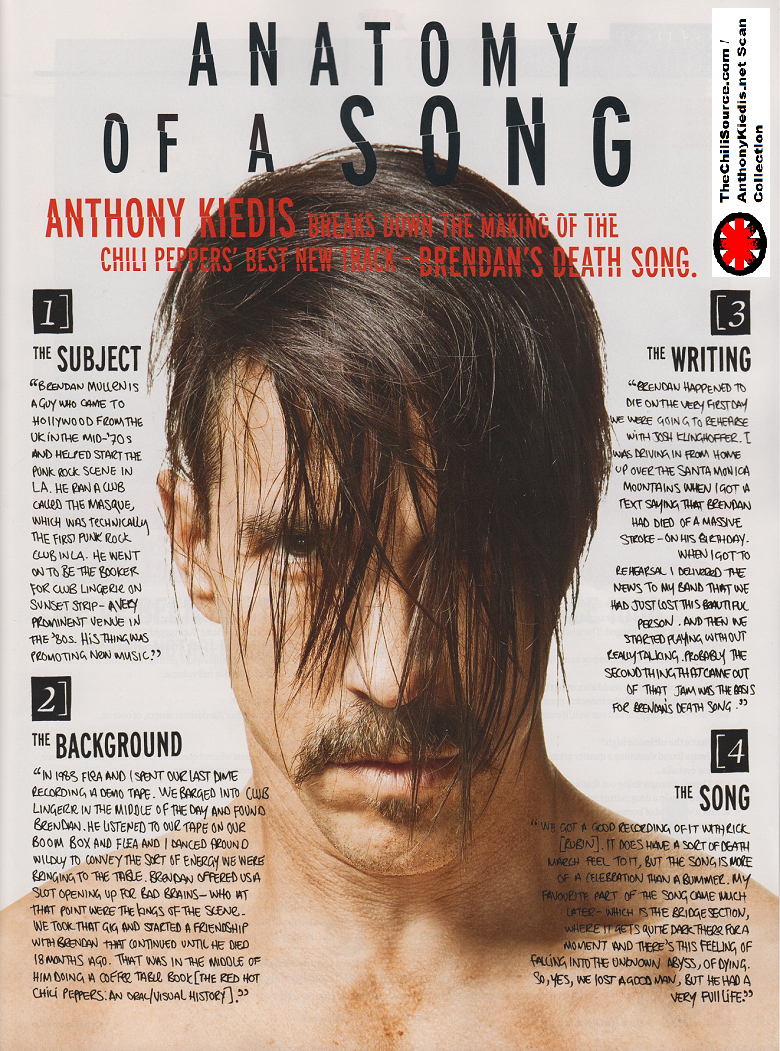
 When I was listening to the newest Red Hot Chili Pepper album, I'm with You, I discovered the song "Brendan's Death Song". The interesting lyrics really caught my attention. "Let me live, so when it's time to die, even the Reaper cries. Let me die so when it's time to live another sun will rise."
Brendan Mullen was a nightclub owner in LA. The Red Hot Chili Peppers credit him with giving the band their start. He was a friend to the band for many years and died in 2009, shortly after his 60th birthday, of a massive stroke.
The day the band found out about his death was the first day of rehearsal with their new guitarist Josh Klinghoffer. From lead singer Anthony Kiedis, "When I got to rehearsal I delivered the news to my band that we had lost this beautiful person. And then we started playing without really talking. Probably the second thing that came out of that jam was the basis for Brendan's Death Song." Kiedis goes on to say that while the song does sound like a death march, they mean it to be a celebration. "My favorite part of the song came much later-which is the bridge section, where it gets quite dark for a moment and there's this feeling of falling into the unknown abyss of dying. So, yes, we lost of good man, but he had a very full life."
Well if I die before I get it done will you decide?
Take my words and turn them into signs they will survive,
Because a long time ago I knew not to deprive.
It's safe out there now your every where just like the sky,
And you are love, you are the lucid dream you are the ride
And when you hear this you know it's your jam it's your good bye
Like I said you know I'm almost dead, you know I'm almost gone
And when the drummer drums he's gonna play my song to carry me along
Like I said you know I'm almost dead, you know I'm almost gone
And when the boatman comes to ferry me away to where we all belong
We all cross when we were feeling lost it's just the time.
Kateri cried the day her lover died, she recognized,
Because you gave her a life of real love it's no surprise.
The nights are long but the years are short when you're alive,
Way back when will never be again it was a time.
It's gonna catch you so glad I met you to walk the line.
Like I said you know I'm almost dead, you know I'm almost gone
And when the drummer drums he's gonna play my song to carry me along
Like I said you know I'm almost dead, you know I'm almost gone
And when the boatman comes to ferry me away to where we all belong
Like I said you know I'm almost dead, you know I'm almost gone,
And when the drummer drums he's gonna play my song to carry me along.
Like I said you know I'm almost dead, you know I'm almost gone,
And when the boatman comes to ferry me away to where we all belong.
Let me live, so when it's time to die, even the Reaper cries.
Let me die so when it's time to live another sun will rise.
Yeah, yeah yeah, yeah yeah
Like I said you know I'm almost dead, you know I'm almost gone
And when the drummer drums he's gonna play my song to carry me along
Like I said you know I'm almost dead, you know I'm almost gone
And when the boatman comes to ferry me away to where we all belong
Like I said you know I'm almost dead, you know I'm almost gone
Like I said you know I'm almost dead, you know I'm almost gone
Like I said you know I'm almost dead, you know I'm almost gone
Monday, September 12, 2011 0
Monday, June 13, 2011
 Watching the evening news a while back I enjoyed the interview of music legend Paul Simon with Brian Williams on NBC. My ears pricked up when I heard the following part of the interview:
PS: "I'm not crazy about dying"
BW: "I don't know a big fan...."
PS: "No, not too many. I'm trying to come... I'm trying to not be pissed off about that" and a little later...
PS: "We were always told that your capacity for thinking sort of diminishes as you get older...but now I'm 69 years old and I think the opposite, I think that it's better. So I look forward to seeing what more time will reveal."
Immediately I wondered about Simon's contemplation on aging and death. I went to work looking at his repetoir of songs to find out what he's been saying in his lyrics about death over the last 4 decades.
The first I found was released in 1972 entitled "Mother and Child Reunion". From an interview with Rolling Stone that same year Simon explained the inspiration; "Last summer we had a dog that was run over and killed....It was the first death I had ever experienced personally....I felt this loss - one minute there, next minute gone, and then my first thought was, "Oh, man, what if that was [my wife] Peggy? What if somebody like that died? Death, what is it, I can't get it"
Knowing the inspiration then, the lyrics to the song fit, "I can't for the life of me/ Remember a sadder day/ I know they say let it be/ But it just don't work out that way/ And the course of a lifetime runs/ Over and over again." However, just listening to the melody and upbeat tempo, you'd be hard pressed to hear this and think it was a mournful song.
In 1977 Simon released "Slip Slidin' Away". There is not a lot of background known as to the inspiration for this piece, but clearly, there are palliative care themes in this. Many think the "destination" described in the chorus represents death, others may quip that it is a metaphor for any goal or hope for one's life. Regardless the 4th stanza that says "God only knows/ God makes his plan/ The information's unavailable/ To the mortal man/ We work our jobs/ Collect our pay/ Believe we're gliding down the highway/ When in fact we're slip slidin' away" sounds a lot like someone who is aware of their own mortality.
"The Late Great Johnny Ace" was released in 1983 and is very autobiographical. Simon was 42 when this was released, and you can sense his maturity in the song. We are taken on a journey revolving around death and life. The song opens with Simon as a 12 year old hearing about Johnny Ace's death. Too young to really comprehend this reality, yet somber still the same, the song then shifts dramatically in tempo and melody to a more joyous time of the 60's. The listener has the sense that Simon feels young and immortal. The final third part changes back to the opening melody as Simon hears of John Lennon's death. He connects the news back to the late Johnny Ace's death, except now the sentiment is more personal. I find it haunting that the song concludes with a Phillip Glass instrumental piece, bringing an emotional climax to mortality, as one can imagine in the pulsating melody a clock ticking one's life away.
Finally we turn to Simon's recent album So Beautiful, or So What released this April. Just as the opening interview with Brian Williams suggested, Simon, now 69 years old, is even more aware of issues regarding aging and death. There are a couple of songs on this album that deal with death and mortality. In "The Afterlife" he pokes fun at death with the opening words, "After I died, and the makeup had dried, I went back to my place" and near the end "After you climb, up the ladder of time, the Lord God is near. Face to face, in the vastness of space, your words disappear."
The more serious is "Love and Hard Times", which though not directly discussing death, is certainly a life reflection. The beginning sets up the human condition with a narrative about God coming and then deciding to disappear, "anyway, these people are slobs here". The song then moves into a love ballad, and three stanzas cover their first meeting, hard times when love was gone and finally a present moment of gratitude. The last verse could easily be someone on their death bed, in a still room, "The bedroom breaths in clicks and clacks/ Uneasy heartbeat, can't relax/ But then your hand takes mine/ Thank God, I found you in time"
All in all when I reflect over these works that cover 40 years I get the sense that Paul Simon has often been reminded that life is short. I get the feeling that this awareness allows him to focus on the important things. His statement then "I'm not too crazy about dying" may be less a fear or denial of death, than a realization that he has much more life to live, because life is good these days.
Monday, June 13, 2011 0
Monday, April 18, 2011
 I'm doubtful there is anyone reading this who actually owns this CD. I came across it doing some internet browsing. The CD is "Dead and Gone # 2: Totenlieder - Songs of Death" (1997). Although released in Germany, the majority of songs are actually in English.
It's very eclectic, and reminds me of someone making a CD for a friend, just sticking a lot of random songs about death onto a disc. I went on a little journey though, attempting to find some examples of some of the songs and was definitely introduced to some new music. However, I still can't decide if this was a serious attempt at a compilation or a joke.
When I say eclectic, I am not exaggerating. For instance the opening track comes from an alternative rock group from Australia named The Beasts of Bourbon. You can listen to "Rest in Peace" on Youtube. This is followed by a dark piece by the prolific poet, actress, singer/songwriter Lydia Lunch called "Gloomy Sunday" The song, mostly spoken, seems to discuss suicide as the lyrics say "Soon there'll be candles and prayers that are said I know, but let them not weep, let them know that I'm glad to go"
Listening to some of the very old traditional songs like "Whisper Softly, Mother's Dying" (1928) I was struck with the potential history preserved on this album. You'll hear what I mean if you follow the link above to a short 30sec. clip of the song.
One of the most frightening songs of the album is a piece by avant-garde opera and jazz musician Diamanda Galas entitled "Cris D'Aveugle" (Blind Man's Cry) taken from a text written in 1873. The song is full of whispers and screaming. Overall, the song seems more suited to a haunted house exhibit.
Probably the most musically pleasing song to me was the 4th track from the group Miranda Sex Garden. The group is a female trio who generally sings a Capella madrigal music. Their song "Gush Forth My Tears" has been remixed many times. The harmonies are beautiful and the lyrics quite simple; "Gush forth my tears/
and stay the burning/of my poor heart/or her eyes/choose you whether/o' peevish fond desire/alas my sighs
sighs out/still blow the fire"
Finally I must mention the closing song by Gary Floyd "From the Darkness to the Light" (1999). Although meant to be uplifting, in the traditional up beat blue grass tempo, the song's meaning is much more macabre. The lyrics "We are moving from the darkness to the light. Rest has come, our battles done, we've won the fight" are discussing someones actual dying process. What I find a bit eerie is the way musically voices are added to the chorus, as if more and more people are dying. The end, is even more haunting with 2 child voices finishing up this energetic melody, as if they too are happy to be dying.
In sum, a unique compilation of mostly unknown music. If I think of each piece as 'art' rather than radio music material, I can enjoy it a bit more.
Monday, April 18, 2011 8
Monday, April 4, 2011

There surely is a cathartic aspect to listening to songs that make you cry, as evidenced on a recent home visit of mine. I was seeing a young cancer patient, and the TV was set on CMT, with country videos playing in the background. What shocked me was that the patient's young wife and friends had me pause to watch part of a video in which the theme of the song was about death. The wife commented, "We just love these songs, and sit here and cry with them all day" (As if there wasn't reason enough).
Well, there are plenty of country songs to cry about. In fact, there may be enough songs to actually form an unofficial sub-genre called 'Cancer Country' as mentioned by Ron Rosenbaum in a 2007 article published on Slate.com.
So, if you are a country music fan or have friends or patients who are, add these next songs to your repertoire of emotional songs about people with cancer. The warning label on these should read "may induce tears"
The oldest on my list is Tim Mcgraw's "Live Like You Were Dying" written by Tim Nichols and Craig Wiseman in 2004. The song is associated with Tim Mcgraw's father who was diagnosed with a brain tumor in 2003, living 9 months after diagnosis. These lyrics set up the song, "I spent most of the next days, looking at the x-rays, Talking bout' the options and talking bout' sweet times. I asked him when it sank in, that this might really be the real end. How's it hit 'cha when you get that kind of news?"
In 2005 Rascal Flats released the single "Skin" written by Joe Henry and Doug Johnson. Known by fans as "Sara Beth" the song is about a girl with Leukemia going to her prom. An example of the lyrics, "Sara Beth is scared to death, as she sits holding her mom, 'cause it would be a mistake for someone to take a girl with no hair to the prom"
Craig Morgan released his single "Tough" in 2007. This song is about a breast cancer surviver who teaches her husband a lesson about being 'tough'. The lyrics say it all, "She wore that wig to church, pink ribbon pinned there on her shirt, no room for fear, full of faith, hands held high singing Amazing Grace. Never once complained, refusing to give up, and I thought I was tough"
Finally, Randy Owen, former vocalist in the band Alabama, released his first solo single in 2008 entitled "Braid My Hair" written by Chris Gray and Brent Wilson. The song is about a bald headed girl going through chemotherapy and dreaming about what she will do once she's well, as the lyrics state, "I'm gonna ride my bike, I'm gonna climb a tree. Gonna fly a kite, score running little league. I'm gonna go to school, make a friend, be able to run again. Take off my mask and just breath in the air. But most of all I'm gonna braid my hair."
Besides being about cancer, each of these songs has another central theme- one we in Palliative Medicine talk about a lot - the theme of 'quality of life' living. Each central person is dreaming about and attempting to live a full life in the midst of disease.
Anyone know of any other "cancer country" songs that should be included?
Monday, April 4, 2011 6
Monday, February 21, 2011
 This is a guest post from Eric Holmstrom. (I wasn't able to find a full version of the song to post but you can listen to a sample here.) I had never heard this song before Eric emailed me. It now has an honored position on my playlist. Thanks Eric! And thanks to everyone who sends us great posting ideas.
Monday, February 21, 2011 1
Monday, September 13, 2010
I found this song when I was doing research on strange songs people wanted to have at their funerals. I don't know if it's funeral worthy but it is an interesting song. Dead by They Might Be Giants came out on their album Flood in 1990. Dead, like many of their songs is... quirky. (The song is below and you can see the lyrics at the end of the post.)
My initial thought was that it is sung from the point of view of a person who died young or wasn't ready to die-"Accidently taken off the shelf before the date stamped on myself". (Reincarnated as a bag of groceries?) He expresses a lot of regrets about the things he won't ever get to do and wonders how the event (his death) was taken.
After listening to the song a couple times, I changed my view. Maybe it's not someone physically dead but someone who just feels that way. Or maybe he is dead and just lived a life very similar to being dead. "Now it's over I'm dead and I haven't done anything that I want or, I'm still alive and there's nothing I want to do"
They Might Be Giants don't really give a lot of clues as to what they were thinking with their songs. They have on occasion said that some of their songs really don't have a deeper meaning (or even a meaning) to the lyrics but this song seems like it does. Whether they speak of a physical death or more of a spiritual one is open to interpretation.
Dead
I returned a bag of groceries
Accidently taken off the shelf
Before the expiration date
I came back as a bag of groceries
Accidently taken off the shelf
Before the date stamped on myself
Did a large procession wave their (Did a)
Torches as my head fell in the basket, (large pro-)
And was everybody dancing on the casket? (cession dance?)
Now it's over I'm dead and I haven't done anything that I want (now it's over)
Or, I'm still alive and there's nothing I want to do
I will never say the word
"Procrastinate" again; I'll never
See myself in the mirror with my eyes closed
I didn't apologize for
When I was eight and I made my younger brother
Have to be my personal slave
Did a large procession wave their (Did a)
Torches as my head fell in the basket, (large pro-)
And was everybody dancing on the casket? (cession dance?)
Now it's over I'm dead and I haven't done anything that I want (now it's over)
Or, I'm still alive and there's nothing I want to do
(So) So I won't
(Sit) sit at home
(And) anymore
(And) and you won't
(And) see my head in
(And) the window
(And) and I won't
(And) be around
(And) ever anymore
(And) and I'll be up there on the wall at the store
I returned a bag of groceries
Accidently taken off the shelf
Before the expiration date
I came back as a bag of groceries
Accidently taken off the shelf
Before the date stamped on myself
Did a large procession wave their (Did a)
Torches as my head fell in the basket, (large pro-)
And was everybody dancing on the casket? (cession dance?)
Now it's over I'm dead and I haven't done anything that I want (now it's over)
Or, I'm still alive and there's nothing I want to do
Now it's over I'm dead and I haven't done anything that I want (now it's over)
Or, I'm still alive and there's nothing I want to do
Monday, September 13, 2010 2
Sunday, June 13, 2010
One of my favorite bands, Nada Surf, recently came out with a new album of covers and to whet my appetite before I could get my hands on some digital mp3's I went back to some of their old albums and listened to them all the way through. One song kept sticking out to me because a few lines really resonated with a convergence of work/family overload I recently experienced. But as I dug out from that overload I started to see the song differently and through the eyes of some of the family members of patients who were dying.
Here is a video of Nada Surf performing "Do It Again" live in a record store (there is no official video and check out the cool drum box the drummer is using, it is called a cajon and is very fun to play!):
The main lyric that first caught my attention was near the end of the song when the energy picks up from the mid tempo relaxed arrangement used for most of the song. The lyric is:
Maybe this weight was a gift / Like I had to see what I could lift
I spend all my energy / Walking upright
Well I'd snap to attention / If I thought that you knew the way
I'd open my mouth / If I had something smart to say /
I bought a stack of books / I didn't read a thing
It's like I'm sitting here / Waiting for birds to sing
- temperance
- passion
- womanhood (China)
- take care of yourself for me
- fragility
You're lying down / And the moon is sideways
And I like the masking noise quiet / Of your breathing nearby
No temptation has seized you except what is common to man. And God is faithful; he will not let you be tempted beyond what you can bear. But when you are tempted, he will also provide a way out so that you can stand up under it.While it mentions temptations and not more specifically trials, you could see the basic sentiment exists that has launched many self-help books. People endure many different hardships throughout their life and eventually most get through it but they have changed, some for good and some for worse. How one emerges from the tough times is up to the individual and their support system, but it may sometimes turn out that 'the weight was a gift.' Just don't tell that too them in the middle of their journey. That is only something that should be self-discovered.
Lyrics: (2005 Barsuk Records - The Weight is a Gift)
Well I'd snap to attention / If I thought that you knew the way
I'd open my mouth / If I had something smart to say
I bought a stack of books / I didn't read a thing
It's like I'm sitting here / Waiting for birds to sing
Let's do it again
Come on let's do it again
Please let's do it again
The hum of the clock / Is a far-away place
The azalea air holding your face / You're lying down
And the moon is sideways / (From the hot to the cold It never gets old)
I spend all my energy / Staying upright
And I like the masking noise quiet / Of your breathing nearby
I want you lazy science / I want some peace
Are you the future? / Show me the keys
When I accelerate / I remember why it's good to be alive / Like a twenty-five cent game
Maybe this weight was a gift / Like I had to see what I could lift
I spend all my energy / Walking upright
Sunday, June 13, 2010 9
Monday, May 24, 2010
 For clinicians looking for medical songs to pull out for discussion, you may want to add this song by French actress and singer Charlotte Gainsbourg. The song, IRM is from her new album of the same name. IRM, the album, was released Jan. 26, 2010 on the Elekra/Asylum label. Co-written, mixed and produced by Beck, the album is described by Michael Katzif from NPR as having "lyrical subtlety and layered details that unspool upon each listen"
The title song, IRM, is the french name for MRI, as in Magnetic Resonance Imaging. The background story is that in 2007 Charlotte had a skiing accident in the states. After the minor accident she began having headaches, and subsequent serial MRI's were preformed. Ultimately she required surgical decompression from a hematoma.
She says that during the MRI procedures, she'd listen to the whirring of the machine thinking what great background it would make for a song. While many of us may hear sounds in our daily lives that we randomly think could fit into a song- she did it. But it's not just background, the lyrics themselves are about the procedure as well. Below are the lyrics and then song:
Take a picture, what's inside?
Ghost image in my mind
Neural pattern like a spider
Capillary to the centre
Hold still and press the button
Looking through a glass onion
Following the x-ray eye
From the cortex to medulla
Analyze EKG
Can you see a memory?
Register all my fear
On a flowchart disappear
Leave my head demagnetized
Tell me where the trauma lies
In the scan of pathogen
Or the shadow of my sin.
Anyone who's had an MRI, or been around them won't have trouble hearing the machine sound. I even think the drum beat has the sound of a tachycardic pulse. The lyrics help contrast so well the impersonal world of medicine with the idea of being human, i.e. "can you see a memory?"
Here's the song from YouTube below.
Monday, May 24, 2010 1
Monday, April 12, 2010
If you attended our talk at the Academy meeting, you will recognize this song. I Don't Want to Die (In the Hospital) by Conor Oberst and the Mystic Valley Band was released in 2008 on his album Conor Oberst. I think it's a fun listen in general and especially for anyone in the hospice and palliative care field. I thought it deserved its own post. Enjoy!
The first thing that strikes me about this song is the upbeat music for such a serious topic. It's not the tone you would expect for talking about how one would like to die. With the same lyrics but different music, it could be a very different song. In an interview with Oberst, he talks about what he was thinking when he wrote this song.
"I think it has a sort of comedic aspect to it. The juxtaposition of the music and what's being sung about I suppose. ... I just think of sort of a stubborn old cowboy man that just wants to go lay in the grass and, you know, die out by the tree or something. "
The comical lyrics make me realize how I take the hospital experience for granted. Horrible gowns, bad TV, small sterile rooms, unable to do the things you enjoy most. Put that way, probably not the setting I would choose to spend my last days in. To some, this would be like a prison.
As the song gets closer to the end, the singer begins to sound more desperate. At one point he changes "I don't want to die in the hospital" to "I don't want to die". His voice sounds a bit crazed at times. Is there some terminal delirium there at the end?
I was just listening to this song again as I write this post and I had a moment. I was remembering several experiences of confused patients in the hospital who just kept getting up trying to leave. (I have even had an experience where the patient was wanting to find his shoes so he could take off.) They just keep say "Help me get up. I've gotta go" over and over. Couldn't say where they wanted to go but just wanted to get out of the hospital. The repetitive lyrics of the song remind me of that. Maybe I should have listened more closely to what they were telling me.
Below are the lyrics to I Don't Want to Die (In the Hospital).
I don’t wanna die in the hospital
No I don’t wanna die in the hospital
No I don’t wanna die in the hospital
You gotta take me back outside
I don’t wanna hear all those factory sounds
Looking like the girl in the sleeping gown
I don’t wanna die in the hospital
You gotta take me back outside
Can you make a sound to distract the nurse
Before I take a ride in that long black hearse
I don’t wanna die in the hospital
You gotta take me back outside
Help me get my boots on
Help me get my boots on
Help me get my boots back on
Help me get my boots on
Help me get my boots on
Help me get my boots back on
I gotta go, go, go
Cause I don’t have long
Yeah I don’t give a damn what those doctors say
I don’t wanna spend another lonesome day
I don’t wanna die in the hospital
You gotta take me back outside
They don’t let you smoke and you can’t get drunk
All there is to watch are these soap operas
I don’t wanna die in the hospital
You gotta take me back outside
Can you get this tube out of my arm
Morphine in my blood like a slow sad song
I don’t wanna die in the hospital
You gotta take me back outside
Help me get my boots on
Help me get my boots on
Help me get my boots back on
Help me get my boots on
Help me get my boots on
Help me get my boots back on
I gotta go go go
Cos I don’t have long
Is there still a world at my windowsill
All there ever was I remember still
I don’t wanna die in the hospital
You gotta take me back outside
Don’t know when it’s day or when its night
All I ever see are florescent lights
I’m not gonna die in this hospital
You gotta take me back outside
They give me all these flowers & big balloons
But I’m not gonna stay in this little room
I’m not gonna die in the hospital
You gotta take me back outside
Are the stars still in the sky
Is that fat moon on the rise
Feel the earth against my feet
As the cold wind calls for me
I ain’t gonna die in the hospital
No I ain’t gonna die in the hospital
No I ain’t gonna die in the hospital
You gotta take me back outside
I ain’t gonna die in the hospital
No I ain’t gonna die in the hospital
No I ain’t gonna die in the hospital
You gotta take me back outside
Monday, April 12, 2010 6
Monday, March 22, 2010
If you ever write a 9 minute song you would hope it would be a good one. There are only a few 9 minute plus songs in my song collection but "The Trapeze Swinger" by Iron and Wine is one that stands out. If you have any familiarity with it you may remember it from the end credit sequence in the moderately memorable movie "In Good Company."
Hypnotically repetitive, I would occasionally put this song on repeat to fall asleep to when I lived alone during my palliative medicine fellowship (and my wife had to be in another city for her fellowship.) At first I took the 'please, remember me' line to be more about my long-distance relationship with my wife, but as I continued to listen to it falling asleep after long days of being surrounded by dying people at the hospice house the meaning clearly evolved.
Since the song is so long go ahead and start listening to it as you read the rest of this post.
Iron and Wine is really a one man band led by Samuel Bean. The simple strong structure repeats through the song with little accents placed on each verse by different instruments or Bean's voice. The back and forth nature of the song structure reminds me of being at the beach watching the waves come crashing in and then slowly recede.
The intro begins with soft wind chimes and what sounds like sea shells or a rain stick followed by the basic guitar melody and a chorus of 'oohhh-ohhhhhs.' As the song advances we hear a ton of different instruments: slide guitar, bass guitar, wood blocks, tom toms, percussive metal, an organ played in reverse, tympani drums, upright bass (around 4:53 - my favorite part!), a song played in reverse, piano, and finally a toy whistle. All of these instruments begin to layer into an increasingly complex sound. I can't imagine being the sound mixer on this song!
The lyrics obviously focus on a theme of rememberence and like the instrumentation the repetitive nature allows for different takes on the same theme. here are the first lines of all the verses laid together.
Please, remember me happilyThe perspective of the dying person wanting to instruct those still alive on how to keep the memory (and the legacy) alive is commonly seen in hospice and palliative care. How we as friends, family or staff enhance or suppress this legacy building is not often talked about as openly as this song manages. How would caring for a person who is dying be different if we spent some time with them asking how they would like to be remembered?
But please, remember me fondly
And please, remember me that Halloween
So please, remember me mistakenly
And please, remember me as in the dream
But please, remember me, my misery
And please, remember me seldomly
So please, remember me finally
There are many religious references in the song, but each of them comes with a little bit of the singer's reality. Imagining the heaven with obscene graffiti, or rushed angels who want to get all the new souls through the door place an potentially unknowable realm in earthly terms.
Overall, Bean gives us a bit of poetry mixed with american folk and indie pop that allows you to discover a little something new with each listen. Please share any lines in this song stand out the most to you.
Lyrics by Iron and Wine (aka Samuel Bean) 2004
Please, remember me happily
By the rosebush laughing
With bruises on my chin, the time when
We counted every black car passing
Your house beneath the hill
And up until someone caught us in the kitchen
With maps, a mountain range, a piggy bank
A vision too removed to mention
But please, remember me fondly
I heard from someone you're still pretty
And then they went on to say
That the pearly gates
Had some eloquent graffiti
Like "We'll meet again" and "Fuck the man"
And "Tell my mother not to worry"
And angels with their great handshakes
Were always done in such a hurry
And please, remember me that Halloween
Making fools of all the neighbors
Our faces painted white
By midnight, we'd forgotten one another
And when the morning came I was ashamed
Only now it seems so silly
That season left the world and then returned
And now you're lit up by the city
So please, remember me mistakenly
In the window of the tallest tower
Calling passers-by but much too high
To see the empty road at happy hour
Gleam and resonate, just like the gates
Around the holy kingdom
With words like "Lost and found" and "Don't look down"
And "Someone save temptation"
And please, remember me as in the dream
We had as rug-burned babies
Among the fallen trees and fast asleep
Aside the lions and the ladies
That called you what you like and even might
Give a gift for your behavior
A fleeting chance to see a trapeze
Swinger high as any savior
But please, remember me, my misery
And how it lost me all I wanted
Those dogs that love the rain and chasing trains
The colored birds above their running
In circles around the well and where it spells
On the wall behind St. Peter
So bright, on cinder gray, in spray paint
"Who the hell can see forever?"
And please, remember me seldomly
In the car behind the carnival
My hand between your knees, you turned from me
And said, "The trapeze act was wonderful
But never meant to last", the clown that passed
Saw me just come up with anger
When it filled with circus dogs, the parking lot
Had an element of danger
So please, remember me finally
And all my uphill clawing
My dear, but if I make the pearly gates
I'll do my best to make a drawing
Of God and Lucifer, a boy and girl
An angel kissing on a sinner
A monkey and a man, a marching band
All around a frightened trapeze swinger
Monday, March 22, 2010 12
Monday, March 15, 2010
 Patti Smith is many things; songwriter, poet, visual artist and now author with her new book "Just Kids" published by ECCO in January 2010.
Her first album, Horses, was released in 1975 and led the way to many more punk rock albums and eventual induction to the Rock and Roll Hall of Fame in 2007. Her book, though, is not the tale of her musical career, but of an important relationship early in her life.
 The book "Just Kids" tells of her relationship with photographer Robert Mapplethorpe, whom Patti met soon after moving to New York in 1967. They were two of a kind, aspiring artists who influenced and pushed each other. The book is a tribute to their unique relationship and something she promised Robert she'd write, the day before he died. Robert died in a hospital in Massachusetts from complications from AIDS March 9, 1989. It took her 20 years to do, but Patti Smith fulfilled her promise to her friend.
Patti writes about the moment of his death in her book, "the phone rang and I rose to answer. It was Robert's youngest brother Edward. He told me that he had given Robert one last kiss for me, as he had promised. I stood motionless, frozen, then slowly, as in a dream returned to my chair. At that moment Tosca began the great aria Vissi D'arte 'I have lived for love, I have lived for art'. I closed my eyes and folded my hands. Providence determined how I would say goodbye."
How symbolic and poignant to have such a great aria like Vissi D'arte not only as a theme to their relationship but playing as she heard of his death as well.
While the book tells the tale of their time together, she wrote a song that was a memorial to him and his death. Robert had green eyes, so she used a little emerald bird as the symbol of him.
The lyrics from Memorial Tribute are as follows:
Little emerald bird wants to fly away
If I cup my hand could I make him stay?
Little emerald soul Little emerald eye
Little emerald soul Must you say goodbye?
All the things that we pursue All that we dream
are composed as nature knew In a feather green
Little emerald bird As you light afar
It is true I heard God is where you are
Little emerald soul Little emerald eye
Little emerald bird We must say goodbye
Unfortunately I couldn't find a recording of this song besides the beginning sung in an interview on NPR's morning edition. To hear a snippet of Patti singing a phrase in the studio, checkout this link, then click on listen to the story. The song is at marker 5:57 of the interview.
Monday, March 15, 2010 0
Monday, March 8, 2010
 In putting together our talk for the academy meeting (music with palliative themes for self care) we had a lot of material to work with. We couldn't possibly talk about all of the music we know to have these themes. There were a lot of... I won't say rejects, as they are still great songs. We'll call them honorable mentions. I want to give an honorable mention today to the Canadian folk rock indie band The Weakerthans and their album Reconstruction Site.
This 2003 album is structured around three songs, which are conveniently placed within parentheses so you know which ones they are, (Manifest), (Hospital Vespers), (Past Due). All three songs are written in more of a sonnet form then a typical song. To me they seem more like poetry than songs. The lyrics are even written out on their website in a paragraph form, not the typical form used for song lyrics.
The first of the three songs, (Manifest), starts out as some type of call to action. Maybe its the beginning of a life philosophy. Like wanting to see and notice everything. Take nothing for granted. The song is very upbeat, optimistic about life. It has an almost military type beat that makes it seem even more like a call to arms. Here is a link to the album and the lyrics are below.
I want to call requests through heating-vents, and hear them answered with a whisper, "No." To crack the code of muscle, slacken, tense. Let every second step in boots on snow complete your name with accents I can't place, that stumble where the syllables combine. Take depositions from a stranger's face. Paint every insignificance a sign. So tell me nothing matters, less or more. Say, "Whatever we think actions are, we'll never know what anything was for." If "Near is just as far away as far," and I'm permitted one act I can save, I choose to sit here next to you and wave.
The middle song, (Hospital Vespers) is below.
Doctors played your dosage like a card-trick. Scrabbled down the hallways yelling "Yahtzee!" I brought books on Hopper, and the Arctic, something called "The Politics of Lonely," a toothbrush and a quick-pick with the plus. You tried not to roll your sunken eyes, and said "Hey can you help me, I can't reach it." Pointed at the camera in the ceiling. I climbed up, blocked it so they couldn't see. Turned to find you out of bed, and kneeling. Before the nurses came, took you away, I stood there on a chair and watched you pray.
Now, I won't tell you I completely understand every line. (Per internet lore, "The Politics of Lonely" may be an obscure reference to a chapter title of a book about an explorer. Who could know?) But a song is what the listener gets out of it. To me this speaks to a feeling of disconnect with the medical community. A lot of references to games "card-trick", "scrabbled", "Yahtzee" like the singer feels it's all one big experiment, like a game. I think the overall sentiment is that the hospital is dehumanizing. The patient feels the need to hide away themselves, emotions, spirituality from the hospital community (with the camera as the symbol for that community). Open to interpretation. The music becomes very strange, I thought a bit eerie.
The last song of the album, (Past Due), is much more obvious. The music lightens up. You hear tinkling bells. It sounds like a conclusion. I'll leave the interpretation to you.
February always finds you folding local papers open to the faces "passed away," to wonder what they're holding in those hands we're never shown. The places formal photographs refuse to mention. His tiny feet, that birthmark on her knee. The tyranny of framing our attention with all the eyes their eyes no longer see. And darkness comes too early, you won't find the many things you owe these latest dead: a borrowed book, that cheque you didn't sign. The tools to be believed with, beloved. Give what you can: to keep, to comfort this plain fear you can't extinguish or dismiss.
The album seems to be telling a story with these three songs as the plot: hope, loss, grief, then resolution. Rebuilding life after a loss. Reconstruction, if you will.
Some of the criticism this album got is that it may be a bit too literate. These songs aren't really meant to be sung in the shower. They are meant to be over thought, which is not always what I'm in the mood to do when listening to music. But when I looked at it more like poetry set to music, I think I appreciated it more. In these songs, nothing is accidental. Every word, every note is well thought through and gives meaning. That meaning may at times be so obscure that maybe we weren't meant to completely get what was in the songwriter's head. Maybe we were meant to interpret it for ourselves and give it meaning that is significant to us.
Monday, March 8, 2010 0
Monday, February 1, 2010
 Rachel Flotard is front woman to a Seattle based indie pop group called Visqueen. Their most recent album "Message to Garcia" was released this fall on Rachel's own label Local 638 Records.
The album is really an epitaph to Rachel's father who died April 7, 2008. Rachel spent 7 years living with and care giving for her father who was diagnosed and ultimately died from prostate cancer. Their house was his hospice, and her album, though upbeat was really inspired by the journey she was on with him as he died.
She told Ari Shapiro in an interview on All Things Considered, "Where I was, was in a hospital, or watching Raiders of the Lost Ark for the fiftieth time with my dad and making him a meal he couldn't keep down, this is where I was"
The only slower ballad on the album, is also the song with overt ties to her fathers death, called "So Long". The lyrics are as follows:
I'm gonna live after your gone
and I'm sorry that it took so long
I'm gonna cry I'm gonna moan
but I want it to be on my own.
I'm gonna write while you're in bed
gonna say things for the first time with my own soft hand
I'm gonna tell them all about you
What you did for me all of my life
Now an epiphany, in one dark night
and I 'm sorry, so sorry
that it took so long
What we knew never rested, to stay
I could spend forever apologizing, for one last day
taking with you what you needed to know
that it's all right to turn around and watch me go
And I'm sorry, so sorry
that it took oh it took so long
so long. And I'm sorry that it took so long. Finishing this song before her father's death, Rachel actually played it for him. She says in her interview with Ari, "I played it for my dad once.... not realizing that the lyrics were like 'you're going to die pal'... he was like "is that about me?" (she laughs as she finishes), "and I told him 'no' and I think we went upstairs and had pea soup." Ironic that the lyrics of the song say "I'm going to say things for the first time" implying an honesty and openness, that when it came down to it, was too difficult to acknowledge.
Even the title of the album honors her father. There was an essay written by Elbert Hubbard in 1899 entitles Message to Garcia. The essay was about a solider tasked to preform a daunting mission by getting a message to a Cuban general named Garcia. The key is that this solider asked no questions, made no objections, requested no help, but accomplished the mission. It extols an attitude of working without complaining.
Her father gave Rachel this essay when she was 18, and was constantly referenced by her father. Whenever facing challenges, he father would say, "Are you delivering it [the message to Garcia]" In other words, don't complain, you can accomplish this. Apropos then for a title of an album created in the grief and challenges of loosing a parent. She made no objections, kept working, and in this album, the mission was accomplished; a beautiful epitaph to George Edward Flotard Jr.
I recommend listening to So Long from a link on the left at the All Things Considered interview.
You can see an interview of Rachel and the band from CW11's Underground series below. Her father appears at mark 6:35 in the interview.
Photo of Rachel and father: copyright Steven Dewall
Monday, February 1, 2010 0
Monday, December 21, 2009
 There's a contemporary Broadway musical making it's way across the country this season, having closed on Broadway January 2009. Spring Awakening won 8 Tony's in 2007, including best score and best musical. Set in Germany in the 1890's, it's been referred to as a folk-infused rock musical.
The plot involves an adolescent cast that deals with very controversial themes such as sex, suicide, physical abuse, abortions, as well as education and spirituality. The musical score by Duncan Sheik with lyrics by Steven Sater is really outstanding, and I actually enjoyed the music more than the plot itself.
One of the more mellow and beautiful pieces in the musical comes after the death of one of the characters. Moritz Stiefel is an innocent boy with high expectations placed on him by his father. When he fails his finals at school, his father reacts harshly and with disdain. Moritz ultimately commits suicide and at his funeral the song "Left Behind" is sung.
There are many layers to the idea of being left behind. Traditionally you think of the people who are alive still, as being the ones "left behind", but this song incorporates a concept that it's the parts of the deceased that are left behind. The hopes, wishes, even sadness and fears of people can linger as a part of them, even when they are physically gone.
Here are the lyrics with a YouTube video of the song at the end of this post.
You fold his hands and smooth his tie, you gently lift his chin.
Were you really so blind, and unkind to him?
Can't help the itch to touch, to kiss, to hold him once again.
Now to close his eye--never open them.
A shadow passed, a shadow passed, yearning, yearning
For the fool it called a home.
All thing he never did are left behind.
All the things his mama wished he'd bear in mind,
And all his dad had hoped he'd know.
The talks you never had, the saturdays you never spent.
All the 'grown-up' places you never went.
And all of the crying you wouldn't understand.
You just let him cry, 'make a man out of him.'
A shadow passed, a shadow passed, yearning, yearning
For the fool it called a home.
All things he ever wished are left behind.
All the things his mama did to make him mind.
And how his dad had hoped he'd grow.
All things he ever lived are left behind.
All the fears that ever flickered through his mind.
All the sadness that he'd come to own.
A shadow passed, a shadow passed, yearning, yearning
For the fool it called a home.
And it whistles through the ghosts still left behind.
It whistles through the ghosts still left behind.
Whistles through the ghosts still left behind.
Towards the end of the musical there is another lovely bereavement song. Similar to "Left Behind", the sentiment is remembering those who've died by keeping them alive in the memories of those living. The song is called "Those You've Known" (follow link for full lyrics)
The song is an overlapping melody sung by 3 characters, 2 of which have died. The chorus states, "Those you've known/And lost, still walk behind you/All alone/They linger till they find you." As the song concludes, the living character Melchoir promises, "I'll walk now with them/
I’ll call on their names/I’ll see their thoughts are known. They walk with my heart/And I'll never let them go."
A good promise for those of us living to remember.
Monday, December 21, 2009 2
Monday, November 9, 2009
 Have you ever had that 'Aha Moment'? Have you ever been listening to a song you have heard a hundred times and suddenly it just made sense?
Listening to this podcast from Studio 360 gave me my own 'Aha Moment' as Monica Murphy describes her moment brought on by R.E.M.'s Try not to Breathe and Nightswimming on the Automatic For The People album. It's a very interesting commentary on grief and music and how the two influence each other. I myself have listened to this song many times and never gotten the potential palliative care connection until now.
I couldn't find anything that commented on what influenced the writing of the song, just some comments that the entire album is about dying and mortality. The theories out there include that it is from the perspective of someone contemplating suicide, someone dying, someone already dead. Regardless, it seems to be influenced by someone contemplating mortality. Someone who seems to be making a decision about life and death. They want their loved ones to remember them. They don't want to cause worry or be a burden. Does this sound familiar to anyone else? I can think of many of my palliative care/hospice patients who have shared similar sentiments.
But this is my interpretation. Monica Murphy has an excellent interpretation of her own.
I will try not to breathe
I can hold my head still with my hands at my knees
These eyes are the eyes of the old, shivering and bold
I will try not to breathe
This decision is mine. I have lived a full life
And these are the eyes that I want you to remember, oh
I need something to fly over my grave again
I need something to breathe
I will try not to burden you
I can hold these inside. I will hold my breath
Until all these shivers subside,
Just look in my eyes
I will try not to worry you
I have seen things that you will never see
Leave it to memory me. I shudder to breathe
I want you to remember, oh (you will never see)
I need something to fly (something to fly)
Over my grave again (you will never see)
I need something to breathe (something to breathe)
Baby, don't shiver now
Why do you shiver now? (I will see things you will never see)
I need something to fly (something to fly)
Over my grave again. (I will see things you will never see)
I need something to breathe, oh, oh, oh, oh
I will try not to worry you
I have seen things that you will never see
Leave it to memory me. Don't dare me to breathe
I want you to remember, oh (you will never see)
I need something to fly (something to fly)
Over my grave again (you will never see)
I need something to breathe (something to breathe)
Baby, don't shiver now
Why do you shiver? (I will see things you will never see)
I need something to breathe (something to breathe - I have seen things you will
never see)
I want you to remember
Thanks to R. Scott Lake who sent me the link to the podcast which inspired the above 'Aha Moment'.
Monday, November 9, 2009 1
Monday, September 28, 2009
The nice thing about art is the ability to interpret a piece from your own perspective based on your life experiences and knowledge. Tonight I will attempt a great feat by turning a song about being left alone and ignored on the dance floor into a reminder of the importance of respect in caring for patients.
The Ting Tings released "That's Not My Name" in 2008 and it quickly spread through MySpace and eventually the UK Charts to become a dance club anthem. The catchy yet slightly bratty lyrics feature a frustrated woman who despises being forgotten and never having anyone identify her as someone of worth. The big bass drum beat and hand claps in the opening verse give the song a cheerleading type quality matched by lead singer Katie White's chanting style of singing.
The dramatic pause of music allows the full weight of the lyrics sink in: "With nothing to consider, they forget my name (ame, ame, ame)" the final words like a pitiful echo chamber resonating the isolation the singer feels.
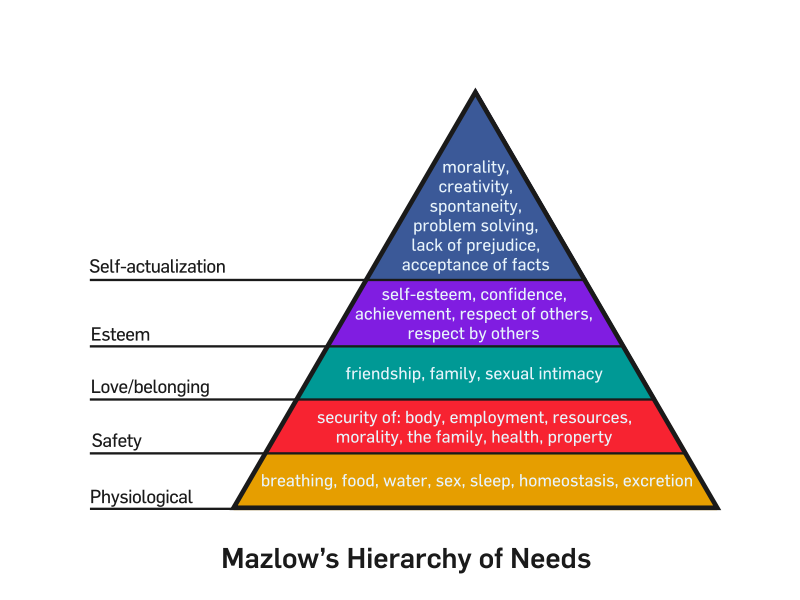
Taking into consideration Mazlow's Hierachy of Needs this song clearly fits into Esteem but also has roots in the Love and Belonging level. One could also consider it as 'continuity of self' and 'maintenance of pride' in Chochinov's Dignity Conserving Perspectives model. (free full text) For the patient with a potential life-altering illness it is difficult to consider being able to 'accept facts' under self actualization if everything in the medical system is designed to dehumanize you one interaction at a time.
The obvious dehumanizing example in the hospital is defining patients not by their name but by age, gender and illness and location as in: "the 54 year old female with lung cancer in the ICU." In addition the gigabytes of data, text and images which define a patient via their ever expanding medical chart (paper or digital) serve a similar dehumanizing role.
Two questions I find very helpful in making a stronger connection with patients include asking about name preference and correct name pronunciation. "Do you like/prefer to be called ______?" "What do your friends call you?" are two easy ways to address name preference. Even if it is classically a term of affection like 'Doll'* or a family relation like 'Gramps' if that is the patients preference even for staff to address them I go with it. (*except when it is not a term they choose themselves - see Elderspeak below)
Correct name pronunciation is probably one of my biggest social pet peeves in medical care today. It flabbergasts me to find highly skilled and well educated professionals stop short of pronouncing a potentially difficult name; often times it may come from a culture different than the majority of staff. If you are going to take a patient for a cholejejunostomy, colonoscopy, phlebotomy, computerized tomography, sunitinib or a palliative extubation you can surely spend 30 seconds to understand how to correctly pronounce their name be it Lee Thi Nguyen or Wilhelmina Van Rijn (not patients of mine)
Another aspect is the singer's identification of personality which also is easily reframed to a patient navigating a complex illness. How the medical system views a patient maybe 'she's quiet' but to the person with the illness she may consider herself in better times 'a riot.'
And lastly the refrain "Are you calling me darling? Are you calling me bird?" resonates with current research in geriatrics demonstrating the use of Elderspeak has a demoralizing effect in geriatric patients. Although calling a patient 'darling,' 'doll' or 'bird' may seem endearing it too becomes another way to dehumanize and individual by tagging them with a generic nickname.
I have left a few other gems in the lyrics for you to interpret on your own. Tell me if you hear some of the same themes when you listen to "That's Not My Name."
"That's Not My Name" by The Ting Tings (Columbia Records UK-2008)
Lyrics:
Four little words just to get me along
It's a difficulty and I'm biting on my tongue and I
I keep stalling, keeping me together
People around gotta find something to say now
Holding back, everyday the same
Don't wanna be a loner
Listen to me, oh no
I never say anything at all
But with nothing to consider they forget my name
(ame, ame, ame)
They call me 'hell'
They call me 'Stacey'
They call me 'her'
They call me 'Jane'
That's not my name
That's not my name
That's not my name
That's not my name
They call me 'quiet'
But I'm a riot
Mary-Jo-Lisa
Always the same
That's not my name
That's not my name
That's not my name
That's not my name
I miss the catch if they through me the ball
I'm the last kid standing up against the wall
Keep up, falling, these heels they keep me boring
Getting glammed up and sitting on the fence now
So alone all the time at night
Lock myself away
Listen to me, Oh nah.
Although I'm dressed up, out and all with
Everything considered they forget my name
(ame, ame, ame)
Male background singing:
Song was my in my head and now its in my mind
call the preacher, get some words and get some time
You know I realized. I cannot emphasize
Sitting around with just a promise, nothing binding
Whatever, can't you see? Living so desperately
Standing and choking like a vocal one-liner
Instead of sing-along this song is monotone
I gotta get some soul. I gotta get some feeling
They call me 'hell'
They call me 'Stacey'
They call me 'her'
They call me 'Jane'
That's not my name
That's not my name
That's not my name
That's not my name
They call me 'quiet'
But I'm a riot
Mary-Jo-Lisa
Always the same
That's not my name
That's not my name
That's not my name
That's not my name
Are you calling me darling?
Are you calling me bird?
Are you calling me darling?
Are you calling me bird?
 Williams KN, Herman R, Gajewski B, & Wilson K (2009). Elderspeak communication: impact on dementia care. American journal of Alzheimer's disease and other dementias, 24 (1), 11-20 PMID: 18591210
Monday, September 28, 2009 0